Rent vs. Buy in 2026: Is Homeownership Still Worth It?
For generations, Americans were told that buying a home is always the smart financial decision. But in 2026 — with mortgage rates still elevated and home prices near record highs — the math is no longer that simple. Here's a data-driven framework to make the right call for your life.
The Financial Reality of the 2026 Housing Market
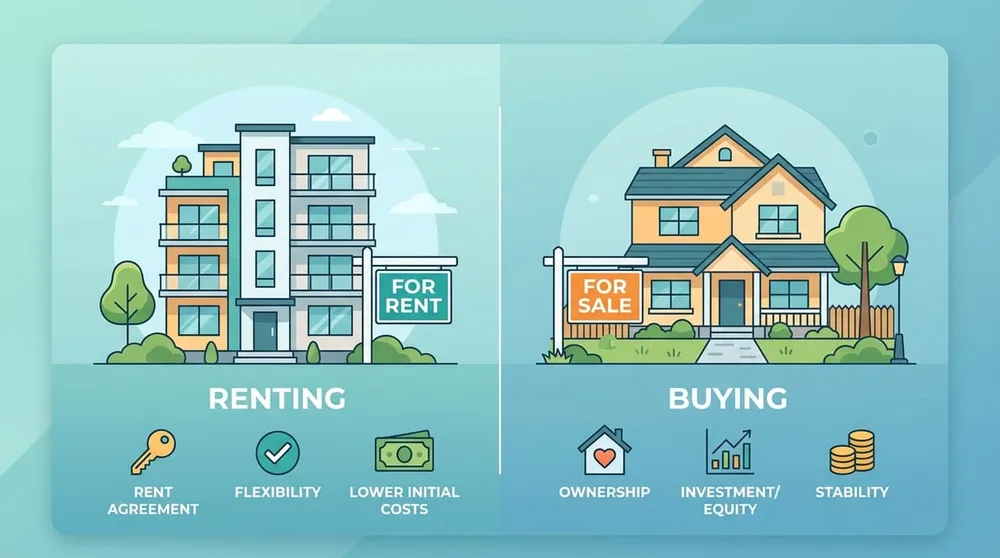
The decision to rent or buy a home in 2026 is fundamentally different from a decade ago. Elevated interest rates and sustained high home prices have shifted the traditional mathematical baseline. The old adage that "renting is throwing money away" is a financial fallacy. Both renting and buying represent consumption of housing, but they carry different capital requirements, risk profiles, and opportunity costs.
A standard 30-year fixed mortgage rate hovering between 6% and 7% significantly alters the purchasing power of the average buyer. To assess whether homeownership represents a sound financial decision, one must compare the unrecoverable costs of renting with the unrecoverable costs of buying. Rent is 100% unrecoverable, but a mortgage payment is heavily skewed toward interest in the early years. Furthermore, buyers face substantial transaction costs, maintenance fees, and capital immobility.
In a high-rate environment, the monthly cash outflow required to purchase a median-priced home often far exceeds the monthly cost of renting an equivalent property in major metropolitan areas. Making the right decision requires looking past societal expectations and calculating specific financial variables applicable to your market and time horizon.
Calculating the True Cost of Homeownership
Comparing monthly rent to a monthly mortgage principal and interest payment is an incomplete metric. Homeownership involves numerous hidden expenses that renters do not bear. To accurately compare the two paths, you must account for the total cost of ownership.
When you buy a home, you assume full responsibility for property taxes, insurance premiums, maintenance, repairs, and potential homeowner association (HOA) fees. These costs are often referred to as unrecoverable expenses.
- Property Taxes: Depending on the state and county, property taxes range from 0.5% to over 2.5% of the home's assessed value annually.
- Homeowner's Insurance: Premiums have risen sharply, particularly in areas prone to natural disasters. Budgeting $1,500 to $3,000 annually is standard.
- Maintenance and Repairs: A prudent benchmark is setting aside 1% to 2% of the property's value each year. A $400,000 home requires roughly $4,000 to $8,000 annually for upkeep (roof repairs, HVAC replacement, plumbing issues).
- HOA Fees: If applicable, these recurring fees can add hundreds of dollars to your monthly obligation and are subject to increases.
- Private Mortgage Insurance (PMI): For down payments less than 20%, lenders typically require PMI, which can cost 0.5% to 1.5% of the loan amount annually.
If renting an equivalent home in the same neighborhood costs $2,500 per month, the renter realizes a monthly cash flow advantage of $1,260. The financial outcome depends heavily on what the renter does with that monthly surplus.
Opportunity Cost: What Renters Can Do With Savings
Opportunity cost is the central financial pillar of the rent vs. buy decision. When a buyer places a 20% down payment on a home, that capital is illiquid. It is tied up in the physical property and cannot be easily accessed or invested in other asset classes, such as the stock market.
Consider a prospective buyer with $90,000 saved for a down payment. If they choose to rent instead of buy, they can invest that $90,000 into a diversified index fund. Historically, the stock market has returned an annualized average of 7% to 9% after inflation.
Furthermore, if renting is cheaper on a monthly basis than owning, the renter can invest the monthly difference. Using the previous example, the renter invests the $90,000 lump sum plus the $1,260 monthly savings. Over ten years, assuming a conservative 7% annualized return, that portfolio would grow to over $390,000.
Home equity does grow over time through principal paydown and property appreciation. However, real estate appreciation historically tracks closer to the rate of inflation (averaging 3% to 5% annually). While leverage amplifies these returns, it also amplifies losses during market downturns. The long-term financial victor depends largely on the discipline of the renter to invest the difference compared to the forced savings mechanism of a mortgage.
The 5-to-7 Year Rule: Break-Even Timelines
Real estate is an illiquid asset with exceptionally high transaction costs. When you purchase a home, you typically pay 2% to 5% of the loan amount in closing costs (appraisals, title insurance, loan origination fees). When you sell a home, you are generally responsible for real estate agent commissions, which can consume 5% to 6% of the final sale price, along with additional closing costs.
These substantial friction costs mean that homeownership requires a sufficient time horizon to break even. If you buy a home and sell it two years later, it is highly likely that the transaction costs will wipe out any accumulated equity or appreciation, resulting in a net financial loss compared to renting.
Amortization schedules heavily weigh interest payments in the early years of a mortgage. In the first five years of a 30-year fixed-rate loan, the vast majority of your monthly payment goes toward the bank's interest, not the principal balance. Because you are building very little equity through principal reduction in these early years, selling the home quickly leaves you dependent entirely on market appreciation to break even.
Inflation, Equity, and Tax Considerations
Homeownership provides a distinct hedge against inflation. A fixed-rate mortgage locks in the principal and interest payment for up to 30 years. As inflation erodes the value of currency, the real cost of your fixed mortgage payment decreases over time. Renters, conversely, are exposed to annual lease renewals and the risk of rising market rents.
Additionally, tax code provisions can benefit homeowners, though they are less universally applicable than in the past. The Mortgage Interest Deduction allows homeowners to deduct the interest paid on the first $750,000 of mortgage debt. However, since the Tax Cuts and Jobs Act of 2017 significantly increased the standard deduction, fewer taxpayers itemize their deductions.
For a single taxpayer in 2026, the standard deduction is substantial. Unless your total itemized deductions (including state and local taxes capped at $10,000, mortgage interest, and charitable contributions) exceed the standard deduction threshold, you receive no additional tax benefit from owning a home. According to data from the IRS, roughly 90% of taxpayers now take the standard deduction.
When you do eventually sell a primary residence, the IRS allows single filers to exclude up to $250,000 in capital gains from the sale (and up to $500,000 for married couples filing jointly), provided they have lived in the home for at least two of the five years preceding the sale. This represents a significant tax advantage available to the middle class.
When Renting is the Clear Financial Winner
Renting remains the superior choice under several specific conditions. If your employment requires frequent relocation, the flexibility of a 12-month lease allows you to seize opportunities without the burden of selling property.
Renting is also appropriate if you lack the necessary down payment and emergency reserves. Purchasing a home with less than 5% down leaves you highly leveraged and vulnerable to being "underwater" if property values decline. Furthermore, entering homeownership without a robust emergency fund specifically designated for repairs is mathematically risky.
Finally, in deeply unbalanced housing markets (such as many coastal tech hubs), the price-to-rent ratio is heavily skewed. When purchasing a property costs 25 to 30 times the annual rent for a comparable home, the monthly cash flow deficit of owning makes it extremely difficult to outpace the returns a renter could achieve by aggressively investing their surplus cash. Use the Emergency Fund Calculator to ensure you are prepared before making any large commitments.
When Buying Makes Mathematical Sense
Buying becomes the optimal strategy when multiple variables align in your favor. The primary condition is a long time horizon. If you intend to remain in the same property for 10, 15, or 30 years, the friction costs of the transaction are amortized over a long period, and the fixed nature of the mortgage serves as a powerful inflation hedge.
Homeownership also enforces disciplined saving. For individuals who struggle to invest the "monthly difference" consistently while renting, a mortgage acts as a forced savings vehicle. Over decades, this principal paydown steadily builds net worth.
Financially, buying makes sense when you possess a 20% down payment (eliminating PMI), hold a strong credit score (securing the lowest possible interest rate), and can comfortably afford the true monthly cost of ownership without exceeding 28% to 30% of your gross monthly income. Before signing a mortgage, run different scenarios through the Mortgage Payoff Calculator to observe how the term length affects total interest paid.
Frequently Asked Questions (FAQs)
Is renting a waste of money?
No. Renting provides shelter, flexibility, and a cap on your maximum housing expenses for the duration of the lease. It shifts the financial risk of maintenance, depreciation, and property tax increases to the landlord. When the unrecoverable costs of owning (interest, taxes, insurance, maintenance) exceed the cost of rent, renting is mathematically advantageous.
How much of my income should go to housing?
A standard financial guideline is the 28% rule, which states that your maximum total housing expense (including principal, interest, taxes, and insurance) should not exceed 28% of your gross monthly income. Extending beyond this threshold increases your vulnerability to financial stress during economic downturns.
What is a price-to-rent ratio?
The price-to-rent ratio is calculated by dividing the median home price in an area by the median annual rent. A ratio between 1 and 15 indicates it is much better to buy than rent. A ratio of 16 to 20 indicates it is typically better to rent, and anything 21 or higher means renting is strongly favored financially.
Do I need a 20% down payment to buy a home?
No, but putting down less than 20% typically requires you to pay Private Mortgage Insurance (PMI). Certain loan programs, such as FHA loans, allow down payments as low as 3.5%, and VA loans offer 0% down options for eligible service members. However, a smaller down payment results in a larger loan balance, higher monthly payments, and more interest paid over the life of the loan. Detailed guidance is available through the CFPB.