Debt Snowball Calculator
List your debts and see the magic of the snowball method. By rolling over your payments, you can eliminate pay off debt fast much faster than you think.
Enter your debts to see your timeline.
Payoff Timeline
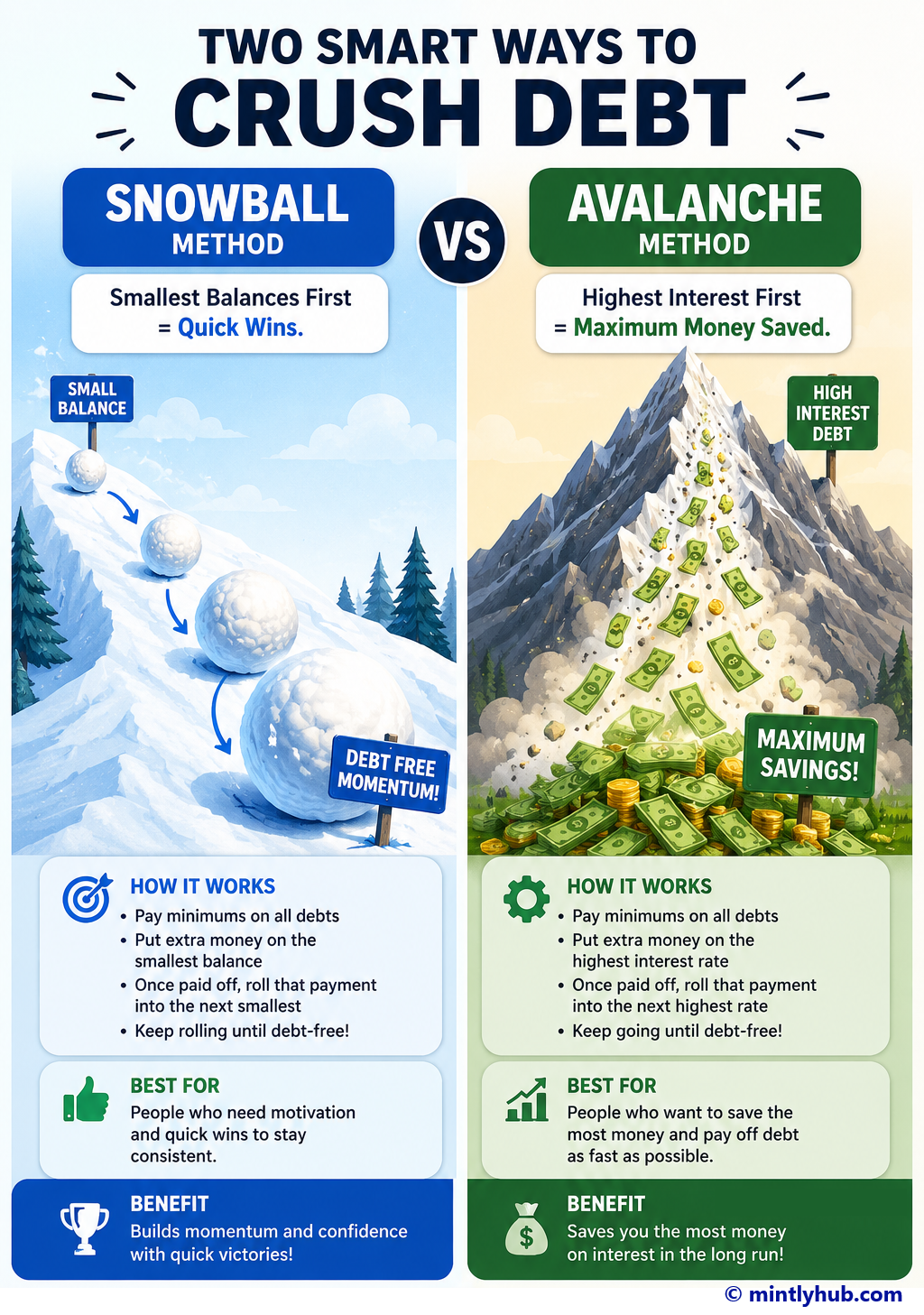
How the debt snowball calculation works
The snowball method pays the minimum due on every debt, then sends your extra payment to the smallest balance. When that balance reaches zero, its former minimum payment is added to the next target. The calculator estimates month-by-month interest from each balance and annual percentage rate, then shows the projected payoff date and total interest.
The avalanche option uses the same cash flow but targets the highest annual percentage rate first. It often reduces interest costs, while the snowball method can create earlier completed accounts. The right choice is the one you can sustain without missing minimum payments.
Worked example
Suppose you owe $600 at 24% APR with a $35 minimum, $2,000 at 19% with a $60 minimum, and $5,000 at 12% with a $125 minimum. With an extra $200 each month, the snowball sends the extra amount to the $600 debt first. Once it is paid, the next target receives the $200 extra plus the freed $35 minimum.
Run both strategies with the same inputs. If the interest difference is manageable, the psychological benefit of an early payoff may matter. If the difference is large, consider the avalanche approach.
Assumptions and limits
This tool assumes fixed APRs, fixed minimum payments, and no new borrowing. It does not include late fees, promotional rates, balance-transfer fees, compounding methods used by individual issuers, or changes in minimum-payment formulas. Continue making at least each required minimum payment. The Consumer Financial Protection Bureau offers consumer debt resources if repayment becomes difficult.
For one card balance, compare the result with the credit card payoff calculator. If your payment is constrained by income, first create a realistic plan with the monthly budget calculator.
Frequently asked questions
Should I close a card after paying it off?
That depends on fees, spending habits, available credit, and your broader credit profile. A payoff plan does not by itself answer whether an account should remain open.
What if the minimum payments exceed my budget?
Contact creditors promptly to ask about hardship options and consider nonprofit credit counseling. Do not ignore notices or stop paying based solely on a calculator result.
✅ What to do next? (Your Action Plan)
Seeing the numbers can feel overwhelming, or it might spark motivation. Either way, here are three tiny, emotionally safe steps you can take today:
- Save your baseline: Screenshot these results or write them down. You now have a concrete starting point, which is the hardest part of any financial journey.
- Read the methodology: Understanding the math will remove the fear of the unknown. Scroll up to the "How to Use Guide" or explore our Glossary to understand exactly what these numbers mean.
- Take a 5-minute win: Pick one tiny action you can do right now from your phone—like logging into your bank to check a balance, setting a calendar reminder for tomorrow, or reading a related article.
