50/30/20 Budget Calculator
The simplest budgeting rule in personal finance. Enter your income and instantly see how to split it into needs, wants, and savings — then track how your actual spending compares.
Full Breakdown
Annual View
Needs
Essential expenses you must pay to live and work. If you stopped working tomorrow, these are what you'd still owe.
- Rent or mortgage
- Groceries & household
- Utilities & internet
- Health & auto insurance
- Minimum debt payments
- Transportation to work
Wants
Things that make life enjoyable but aren't strictly necessary. These are the first to cut in an emergency.
- Dining out & takeout
- Streaming & subscriptions
- Gym & hobbies
- Shopping & clothing
- Entertainment & events
- Vacations & travel
Savings & Debt
Building your future. This is where wealth is built — emergency fund, retirement, investing, and extra debt payoff.
- Emergency fund
- 401(k) / IRA contributions
- Extra debt payments
- General investing
- Down payment savings
- College savings (529)
How the 50/30/20 Formula Works
All calculations use your after-tax (take-home) income, not gross salary. The formula:
Source: Elizabeth Warren & Amelia Warren Tyagi, "All Your Worth" (2005). Endorsed by the Consumer Financial Protection Bureau (CFPB) as a practical budgeting framework.
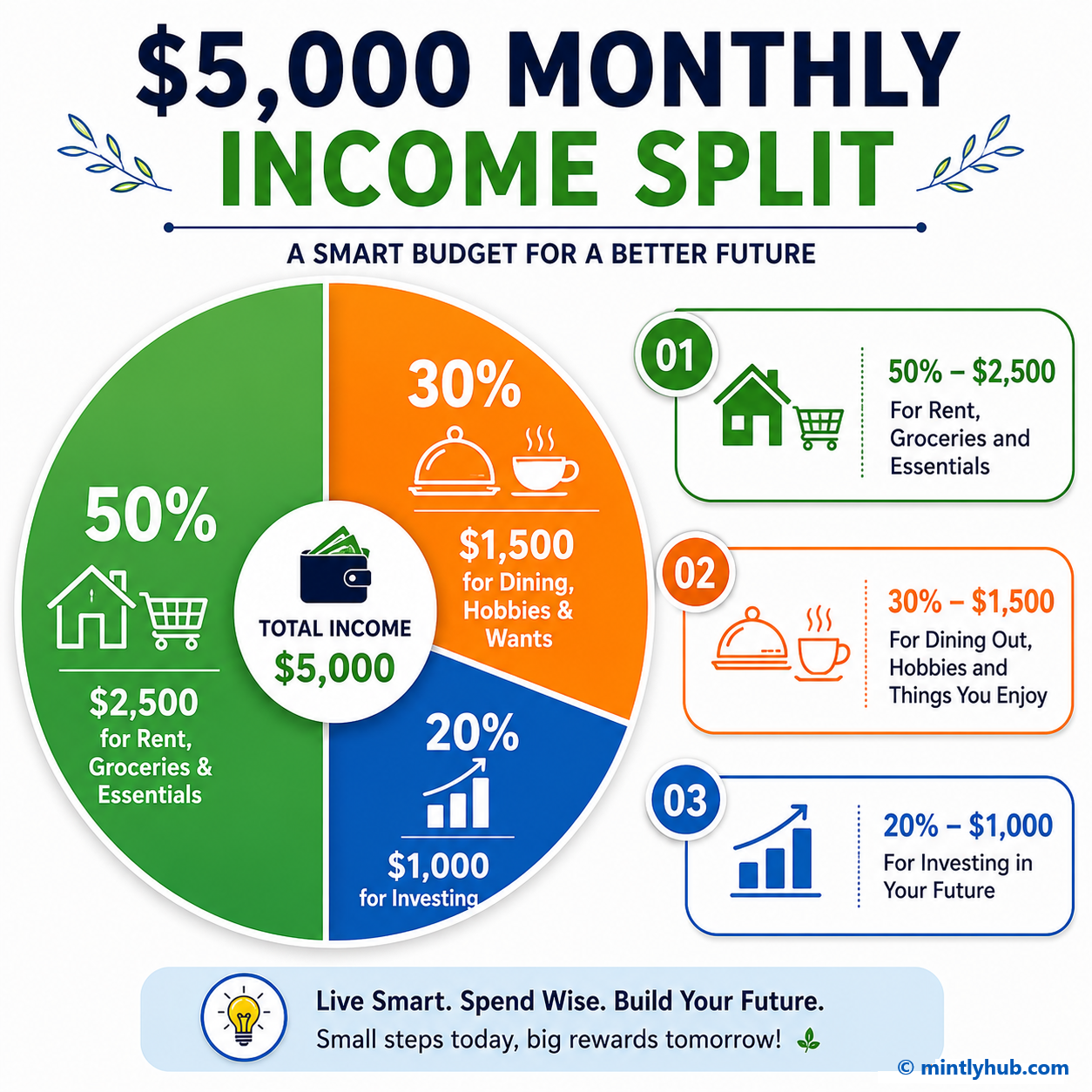
The 50/30/20 Budget Rule: How It Works and How to Apply It
The 50/30/20 framework splits your after-tax income into needs, wants, and savings. By automating these broad categories, it removes the necessity for micro-managing individual expenses. This guide details how our calculator structures this split and how to categorize your expenses accurately. To apply these concepts directly, use our 50/30/20 budget calculator and review budgeting for beginners: a complete 2026 guide. You might also find our guide on the ultimate guide to side hustle taxes in 2026 helpful.

What Is the 50/30/20 Rule?
The 50/30/20 rule is a budgeting framework that models a proportional division of your after-tax income into three structural buckets:
Our calculator processes your net monthly income and automatically calculates the dollar amount for each bucket. This gives you exact expenditure ceilings without requiring a complex spreadsheet. For individuals who prefer simplified personal finance tracking, this method provides broad boundaries rather than granular line-item tracking. The United States Consumer Financial Protection Bureau (CFPB) offers resources that align with structuring a consistent budget strategy.
How to Apply the 50/30/20 Rule Step-by-Step
Input Your Take-Home Income
Find your net monthly pay on your pay stub and enter it into our calculator. If you are paid biweekly, use the formula (net pay × 26) ÷ 12 to find your monthly average. Deductions for health insurance or 401(k) contributions already taken out of your paycheck should be accounted for when you review your 20% savings category.
Review the Target Projections
The calculator outputs your budget ceilings dynamically. Needs = Income × 0.50. Wants = Income × 0.30. Savings = Income × 0.20. These figures establish a baseline. You can use our Compound Interest Calculator to project how the 20% savings component will grow over time.
Audit and Categorize Spending
Review the last 60 days of bank statements to determine your current spending baseline. Compare your actuals to the calculator's targets to identify overspending in the wants category. Document all fixed and variable costs.
How to Classify Needs vs. Wants
Accurate categorization is mathematically vital to this framework. If you incorrectly classify discretionary items as needs, your budget modeling will fail. A "Need" is defined strictly as an expense required for survival or to maintain employment.
| Expense | Category | Why |
|---|---|---|
| Rent / mortgage payment | Need | Essential housing |
| Basic groceries | Need | Essential nutrition |
| Dining out / restaurants | Want | Food choice, not necessity |
| Netflix, Spotify, etc. | Want | Entertainment, not essential |
| Emergency fund contributions | Savings | Future security |
Many individuals confuse lifestyle choices with necessities. For instance, a vehicle may be a need for commuting, but a luxury vehicle lease is a blend of a need (transportation) and a want (luxury). In strict application, base transportation costs are logged under the 50% category, while the premium paid for luxury features should technically fall into the 30% wants category.
What If 50% Isn't Enough?
In high-cost cities, rent and utilities often consume 60% of take-home pay. If the calculator reveals that your fixed needs exceed the 50% threshold, you must rebalance the equation by compressing your wants category. For example, a mathematically valid alternative is a 60/20/20 split. Never reduce the 20% savings bucket to subsidize wants, as this mathematically guarantees negative long-term wealth accumulation.
To reduce fixed needs, consider finding roommates, relocating to a more affordable area, or eliminating vehicle expenses by using public transportation. Adjustments to the 50% category typically require structural lifestyle changes rather than minor daily habit adjustments. The calculation process involves analyzing the specific cost per square foot of housing, monthly utility averages over a one-year period, and base transportation costs.
How to Structure the 20% Savings
The 20% bucket represents all capital allocation for future wealth. It should be directed in an optimal sequence: first to an emergency fund to prevent debt, second to a 401(k) to capture employer matching funds, and third to eliminating high-interest debt. If you are focused on debt elimination, the Debt Snowball Calculator can help structure your payout schedule.
Realistic Scenarios and Applications
Applying the 50/30/20 rule requires consistency across varying income scenarios. Consider an individual with an irregular income, such as a freelancer or commission-based sales professional. The framework still applies, but the calculator baseline must be established using an average monthly income over a 12-month period, or by budgeting based on the lowest earning month to ensure structural stability. When income fluctuates, the fixed costs in the needs category remain static, creating potential cash flow constraints if wants are not aggressively managed.
In another scenario, consider dual-income households. The 50/30/20 rule can be applied to the pooled net income. If Partner A takes home $4,000 and Partner B takes home $6,000, the household net income is $10,000. The calculator will allocate $5,000 to needs, $3,000 to wants, and $2,000 to savings. Managing joint finances with this framework simplifies discussions around discretionary spending, as the $3,000 wants bucket provides clear mathematical boundaries for shared and individual purchases.
✅ What to do next? (Your Action Plan)
Seeing the numbers can feel overwhelming, or it might spark motivation. Either way, here are three tiny, emotionally safe steps you can take today:
- Save your baseline: Screenshot these results or write them down. You now have a concrete starting point, which is the hardest part of any financial journey.
- Read the methodology: Understanding the math will remove the fear of the unknown. Scroll up to the "How to Use Guide" or explore our Glossary to understand exactly what these numbers mean.
- Take a 5-minute win: Pick one tiny action you can do right now from your phone—like logging into your bank to check a balance, setting a calendar reminder for tomorrow, or reading a related article.
