Retirement Savings Calculator
Are you on track to retire? Enter your current savings and monthly contributions to see exactly how large your nest egg will be, and how much monthly income it will generate.
This represents your total liquid portfolio value at retirement.
Journey to Retirement
Principal GrowthHow We Calculate This
This calculator projects your future portfolio value using standard compounding formulas, and estimates your retirement income using the industry-standard 4% rule.
Pro Tip on Inflation: If you use 7% for your return instead of 10%, your results are automatically adjusted for a 3% average inflation rate. This means your final Nest Egg is shown in today's purchasing power.
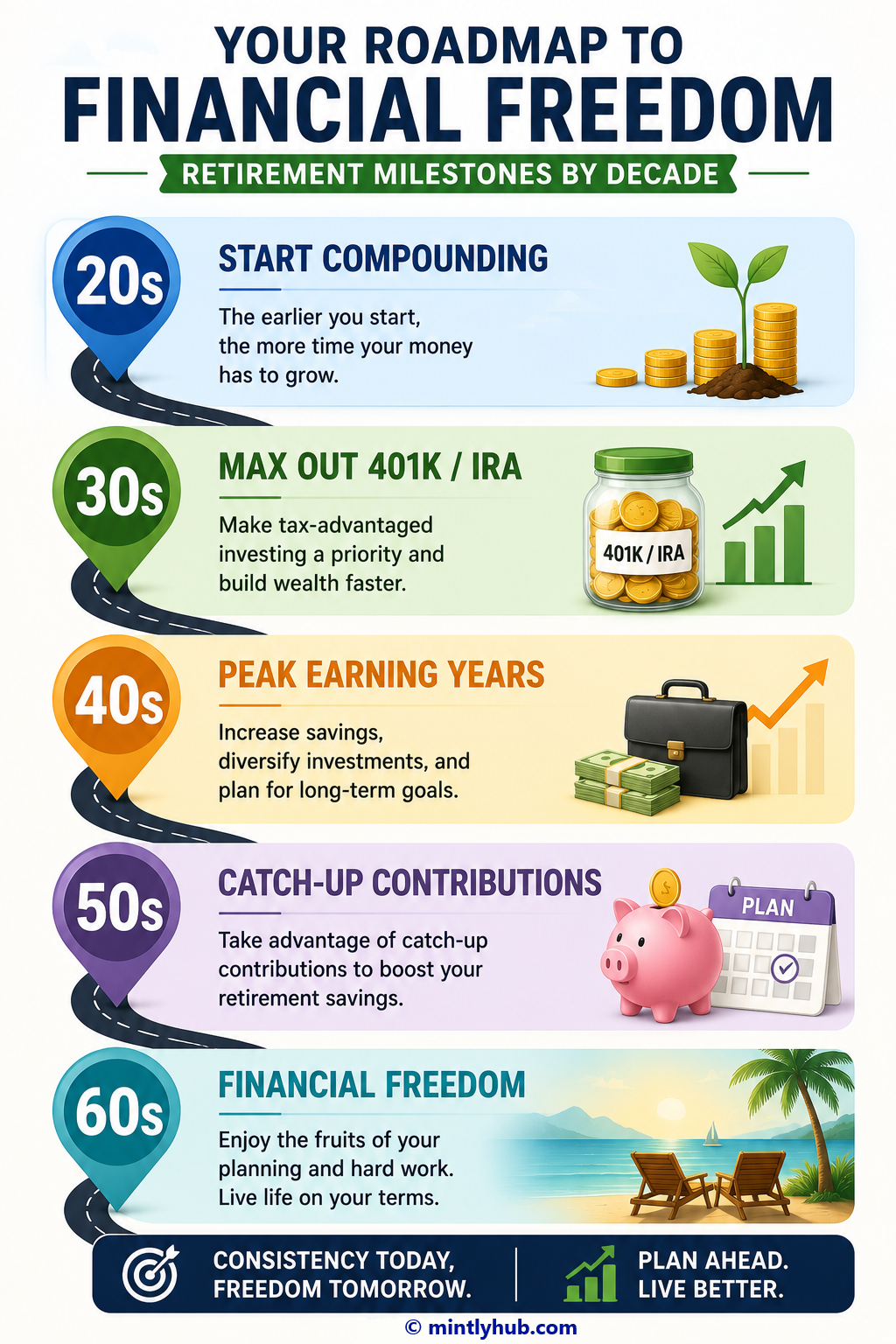
How Much Do You Actually Need to Retire? (The Math Explained)
Most people guess at their retirement number. "I probably need a million dollars." But hope is not a financial plan. Here is the exact mathematical framework you can use to calculate your specific retirement number.

The 4% Rule (The Golden Rule of Retirement)
In 1998, a famous study called the Trinity Study analyzed stock market and bond returns over a 70-year period, including the Great Depression and the 1970s stagflation. The IRS IRA contribution FAQ clarifies annual limits and income phase-out thresholds for both Traditional and Roth accounts.
They wanted to know: How much money can a retiree withdraw from their portfolio every year without ever running out of money before they die?
If you have a portfolio of 50% to 75% stocks (and the rest in bonds), you can withdraw exactly 4% of the total value in your first year of retirement, adjust that amount for inflation every year after, and you have a 95%+ historical probability of never running out of money over a 30-year retirement.
Because of the 4% rule, we can reverse-engineer exactly how big your portfolio needs to be to support your desired lifestyle.
How to Calculate Your Exact Number
Instead of guessing how much money you need, figure out how much you want to spend in retirement, and work backward.
The Rule of 25
Because 100 divided by 4 is 25, you can simply multiply your desired annual income by 25 to find your target nest egg.
- Step 1: Determine desired annual income (e.g., $60,000).
- Step 2: Subtract Social Security or Pensions (e.g., $60k - $20k = $40,000).
- Step 3: Multiply by 25. ($40,000 × 25 = $1,000,000).
If you need your portfolio to generate $40,000 a year for you, you need exactly $1,000,000 invested. Use our Retirement Savings Calculator to see if your current monthly contributions will get you to that million-dollar mark.
Where Should the Money Go?
You cannot save your way to retirement using a standard bank account. Inflation will eat your money alive. To reach these massive numbers, you have to invest the money into the stock market using tax-advantaged accounts.
The 401(k) Match (Free Money)
If your employer offers a 401(k) match, this is your first priority. If they match 5%, you contribute 5%. This is a 100% immediate, guaranteed return on your investment. Do not leave this money on the table.
The Roth IRA (Tax-Free Growth)
After getting your match, open a Roth IRA. You fund this with after-tax money, but the massive benefit is that all of the growth, and all of your withdrawals in retirement, are 100% tax-free.
Index Funds
Do not pick individual stocks. A proven and reliable way to grow wealth is to buy broad-market index funds (like an S&P 500 fund or a Total Stock Market fund). You instantly own tiny pieces of the 500 largest companies in America.
How Inflation Affects Your Nest Egg
One of the biggest concerns people have is inflation. If you need $1,000,000 in 30 years, won't a million dollars be worth much less then?
Yes. Which is why you must calculate your returns in Real (Inflation-Adjusted) Terms.
Historically, the S&P 500 returns roughly 10% per year. Inflation averages roughly 3% per year. If you subtract inflation from the return, you get a "Real Return" of 7%.
When you use our Retirement Calculator, we default the interest rate to 7%. This means the final number you see is already adjusted for inflation. A $1,000,000 result on our calculator means "one million dollars in today's purchasing power."
What If You Are Behind?
If you are 45 with zero savings, the math is harder, but not impossible. You have three primary levers you can pull:
- Save More: You will likely need to save 20% to 30% of your income instead of the standard 10% to 15%. (See our Budget Calculator).
- Work Longer: Pushing retirement from 65 to 68 gives your money three more years of compounding, and increases your Social Security payout by roughly 24%.
- Spend Less in Retirement: If you plan to live on $40k instead of $60k, your target nest egg drops from $1.5 million to $1 million. Paying off your mortgage before retiring is an effective way to reduce your income needs.
Bottom Line
Retirement is not an age; it is a financial number. Once you hit your Rule of 25 number, work becomes optional.
Worked Example & Behavioral Tips
The Plan: He used the Retirement Savings Calculator and found that saving 15% of his income (around $937/month) could still get him to $1.2 million by age 65, assuming a conservative 7% return.
The Outcome: He took advantage of his employer's 401(k) match, which covered part of that 15%. By automatically increasing his contribution by 1% each year when he got a raise, he quickly caught up without feeling squeezed financially.
How to Stick to the Plan
Use "auto-escalation" if your 401(k) offers it, automatically bumping up your savings rate by 1% each year. Treat your retirement contributions as a non-negotiable monthly bill, much like rent or a mortgage, to ensure you pay yourself first.
✅ What to do next? (Your Action Plan)
Seeing the numbers can feel overwhelming, or it might spark motivation. Either way, here are three tiny, emotionally safe steps you can take today:
- Save your baseline: Screenshot these results or write them down. You now have a concrete starting point, which is the hardest part of any financial journey.
- Read the methodology: Understanding the math will remove the fear of the unknown. Scroll up to the "How to Use Guide" or explore our Glossary to understand exactly what these numbers mean.
- Take a 5-minute win: Pick one tiny action you can do right now from your phone—like logging into your bank to check a balance, setting a calendar reminder for tomorrow, or reading a related article.
