How to Actually Hit Your Savings Goals
We all have things we want to buy, places we want to go, and milestones we want to reach. But without a mathematical plan, a savings goal is just a wish. Here is the step-by-step framework to calculate, automate, and hit any financial goal.
Step 1: Define the Exact Number and Timeline
"I want to save for a house" is a bad goal. It lacks specificity. To build a plan, you need two exact numbers: Target Amount and Target Date.
The S.M.A.R.T. Framework for Finance
- Specific: What exactly are you buying? (e.g., 20% down payment on a $400k house)
- Measurable: How much total cash is needed? (e.g., $80,000 + $10,000 closing costs = $90,000)
- Time-bound: When exactly do you need it? (e.g., 5 years from today)
If your goal is far in the future, don't forget to account for inflation. A wedding that costs $30,000 today might cost $35,000 in three years. Pad your target amount by 5-10% for goals more than 2 years away.
Step 2: Do the Monthly Math
Once you have your total and timeline, you must break it down into a monthly "bill" that you pay yourself. If you need $12,000 in 2 years, you need to save $500 a month.
But the math gets better if you use a high-yield account, because the bank pays part of the bill for you.
Why APY and Compound Interest Matter
If you put your goal money in a standard checking account earning 0.01%, you have to save 100% of the money yourself. If you use a High-Yield Savings Account (HYSA) earning 4% to 5%, compound interest does some of the heavy lifting.
| Goal: $50,000 in 5 Years | Standard Bank (0.01% APY) | HYSA (4.50% APY) |
|---|---|---|
| Monthly Contribution Needed | $833 / month | $743 / month |
| Total Out of Pocket | $49,980 | $44,580 |
| Free Money (Interest Earned) | $20 | +$5,420 |
By simply changing where the money sits, you reduce your monthly burden by $90 and get over $5,000 in "free" money toward your goal.
Step 3: Pick the Right Account
Where you store your money depends entirely on your timeline. The stock market returns ~10% on average historically, but it can crash 30% in any given year.
Short-Term (0-3 Years)
Goal examples: Vacations, wedding, emergency fund.
Where to put it: High-Yield Savings Account (HYSA) or Certificates of Deposit (CDs). You cannot risk losing principal this close to your deadline.
Medium-Term (3-7 Years)
Goal examples: House down payment, starting a business.
Where to put it: Mostly HYSA, CDs, or Treasury Bills. You might put a small portion (20-30%) in conservative index funds, but prioritize capital preservation.
Long-Term (7+ Years)
Goal examples: Retirement, kids' college.
Where to put it: Brokerage accounts (Index funds/ETFs) or tax-advantaged accounts (401k, IRA, 529). You have time to ride out market dips for higher returns.
Step 4: Automate the Execution
If you wait until the end of the month to see "what's left" to put toward your goal, you will fail. Human nature guarantees that extra money will be spent.
Pay yourself first. Set up an automatic transfer from your checking account to your savings account for the exact day your paycheck hits. If you get paid on the 1st and 15th, and your monthly goal is $400, set up an automatic $200 transfer on the 2nd and 16th.
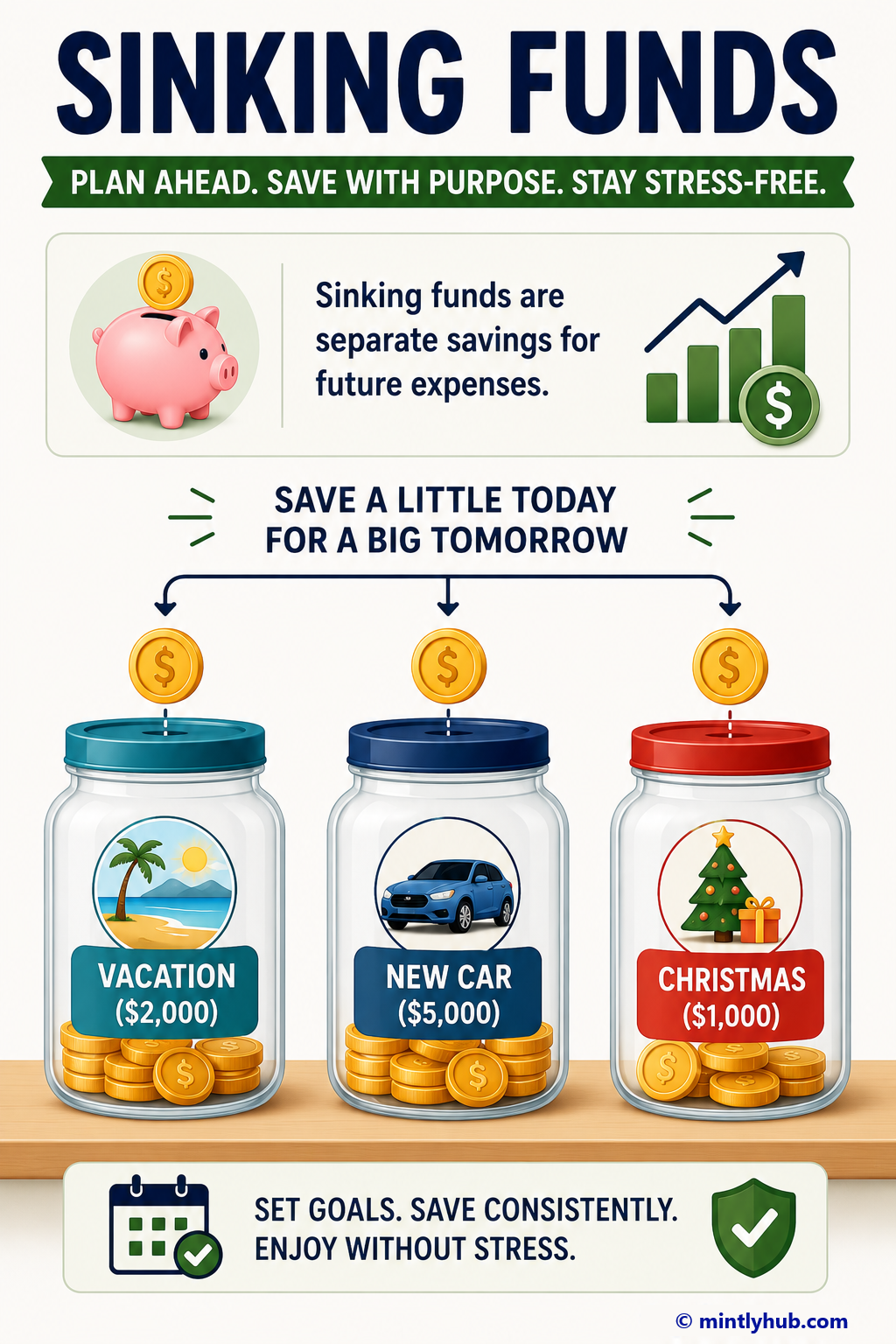
Sinking Funds: The Secret to Annual Expenses
Not all goals are aspirational. Many are just predictable, large annual expenses that derail normal budgets. A sinking fund is a specific type of savings goal for a known upcoming expense.
- Christmas/Holidays: $1,200 spent in December? Save $100/month starting in January.
- Car Insurance: Pay $1,200 annually to get a discount? Save $100/month.
- Property Taxes: Owe $6,000 a year? Save $500/month.
When the bill comes due, it's not an emergency. The money is already sitting there waiting.
Common Mistakes to Avoid
Investing money you need next year
Putting a house down payment in the stock market when you want to buy in 12 months is gambling. If the market drops 20%, your house timeline is delayed by years. Keep short-term money in cash (HYSA).
Setting an unrealistic monthly target
If your budget shows you only have $300 of free cash flow, but your goal requires saving $800 a month, you will burn out and quit. Adjust the timeline (extend the goal date) or increase your income.
Not tracking your progress
Motivation spikes at the beginning and the end of a goal. The "messy middle" is where people quit. Track your progress visually—whether on a spreadsheet, an app, or coloring in a chart on your fridge.
Bottom Line
Achieving financial goals is just an equation: (Time × Monthly Contribution) + Interest = Goal. Decide what you want, let our calculator tell you the monthly contribution required, automate that transfer, and get on with your life.