How to Start Investing With $100 in 2026
"I will start investing when I have more money." This is one of the most expensive phrases in personal finance. The mathematical truth is that starting with $100 today is vastly superior to waiting for a $1,000 lump sum next year. Delaying investment sacrifices the most critical asset you possess: compounding time. Here is the exact blueprint for deploying your first $100.
Prerequisites: Establish Financial Baselines
Before deploying capital into the stock market, you must establish baseline financial stability. Investing a spare $100 while actively carrying high-interest credit card debt is mathematically disastrous. Credit cards often charge upwards of 24% in annual interest, while the stock market historically averages roughly 10%. You cannot out-invest bad debt. Before proceeding, verify you are not exhibiting the signs you are in too much debt.
Additionally, secure a baseline cash reserve. If you invest $100 today and experience an unexpected expense next week, you may be forced to liquidate your investments prematurely, potentially incurring a loss or triggering tax penalties. Maintain a minimum $1,000 cash emergency fund in a high-yield savings account before making your first stock purchase.
Employer Match: The Guaranteed Return
If your employer offers a 401(k) or 403(b) retirement plan with a matching contribution, this must be your absolute first priority for investing. A common employer match structure is 100% of your contributions up to 3% or 5% of your salary.
Consider the mathematics: If you contribute $100 per paycheck and your employer matches that amount, your account immediately receives $200. This represents an instantaneous, guaranteed 100% return on your investment before the money even enters the stock market. No hedge fund manager or real estate investment can reliably replicate a guaranteed 100% upfront return. Maximize this benefit completely before exploring outside brokerage accounts.
Selecting the Right Account: The Roth IRA
Once you have secured your employer match, the next optimal vehicle for your $100 is typically a Roth IRA (Individual Retirement Account). The primary advantage of a Roth IRA is its aggressive tax shielding.
You fund a Roth IRA with after-tax dollars—meaning money that has already been taxed via your standard paycheck. In exchange, the money grows completely tax-free, and all withdrawals in retirement are strictly tax-free. If you invest $100 today and it grows to $1,500 over several decades, you owe the IRS absolutely nothing on the $1,400 of pure profit.
The Core Investment: Total Market Index Funds
A common mistake beginners make is attempting to use their $100 to purchase shares of single, recognizable companies. Picking individual stocks exposes your entire $100 to the operational risk of one executive team and one industry sector.
Instead, use your $100 to purchase fractional shares of a broad-market index fund. But what is an index fund exactly? It is a single fund that holds smaller pieces of thousands of different companies. By purchasing a fund like the Vanguard Total Stock Market ETF (VTI) or the Fidelity ZERO Total Market Index (FZROX), your $100 instantly achieves maximum diversification across the entire United States economy.
Many top-tier brokerages now support fractional share investing. This means that even if a single share of an index fund costs $300, you can execute an order to purchase exactly $100 worth of that fund, receiving exactly one-third of a share.
Automating the Process: Dollar-Cost Averaging
The secret to long-term wealth building is removing human emotion from the process entirely. Markets are volatile. They crash, correct, and rally unpredictably. Investors who attempt to "time the market" by holding their $100 until prices drop consistently underperform.
Implement a strategy known as Dollar-Cost Averaging (DCA). By setting up an automated transfer of $100 on the 1st of every month, you systematically buy shares regardless of current market conditions. When the market is expensive, your $100 buys fewer shares. When the market crashes and goes on sale, your $100 automatically buys more shares at a discount. Automation guarantees consistency.
The Mathematics of Compound Interest
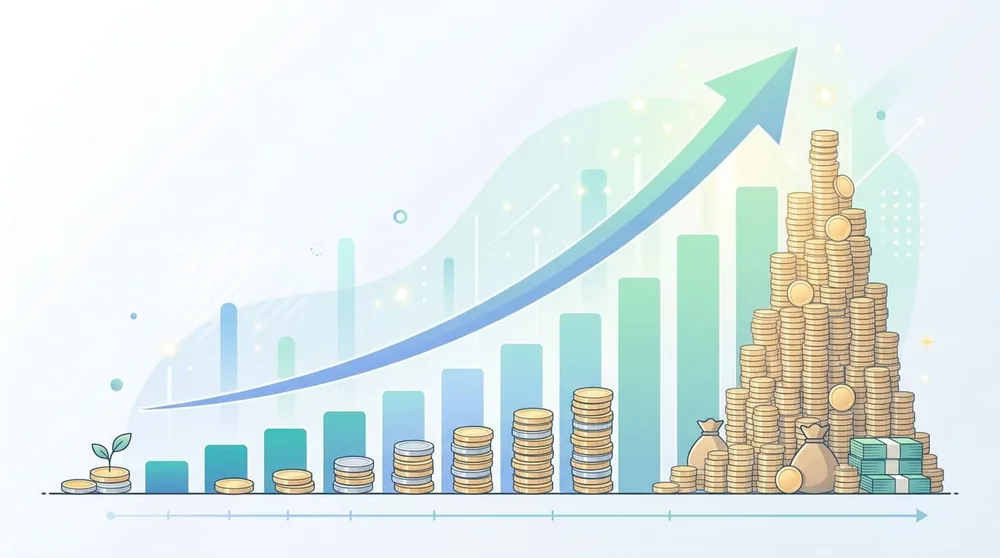
To understand why starting with a seemingly insignificant amount like $100 matters, you must look at the mathematical reality of compound interest over long time horizons. Assuming an average historical annualized return of 10% (the historical average of the S&P 500 before inflation adjustments):
- 10 Years: Investing $100 monthly results in a total balance of roughly $20,000.
- 20 Years: Investing $100 monthly results in a total balance of roughly $76,000.
- 30 Years: Investing $100 monthly results in a total balance of roughly $226,000.
- 40 Years: Investing $100 monthly results in a total balance of roughly $632,000.
In the 40-year scenario, your actual out-of-pocket contribution is only $48,000. The remaining $584,000 is generated entirely by compound growth. The initial $100 is merely the catalyst for this exponential curve.
Frequently Asked Questions (FAQs)
Can I really buy stocks if the share price is higher than $100?
Yes. Most major brokerages now offer fractional shares. If a stock or index fund costs $400 per share, you can simply order $100 worth, and the brokerage will credit your account with 0.25 shares.
What happens to my $100 if the stock market crashes?
The paper value of your investment will decline during a market crash. However, you do not lock in any actual losses unless you sell your shares during the panic. Broad market index funds have historically always recovered and reached new all-time highs following a crash.
Is opening a brokerage account free?
Yes. Reputable brokerages like Fidelity, Vanguard, and Schwab do not charge fees to open an account, do not require minimum deposit balances, and do not charge commission fees for standard stock and ETF trades.
Do I have to pay taxes on my $100 investment right away?
No. You only pay taxes on investments when you receive dividends or when you sell the investment for a profit (capital gains). If you use a tax-advantaged account like a Roth IRA, you avoid these taxes entirely upon qualified retirement withdrawals.