Debt Snowball vs. Debt Avalanche: The Honest Side-by-Side Comparison
These are the two most widely recommended debt payoff strategies in personal finance. Both work. But they work differently, they cost different amounts of money, and they suit different types of people. Here is the complete, no-hype comparison so you can pick the right weapon for your financial war.
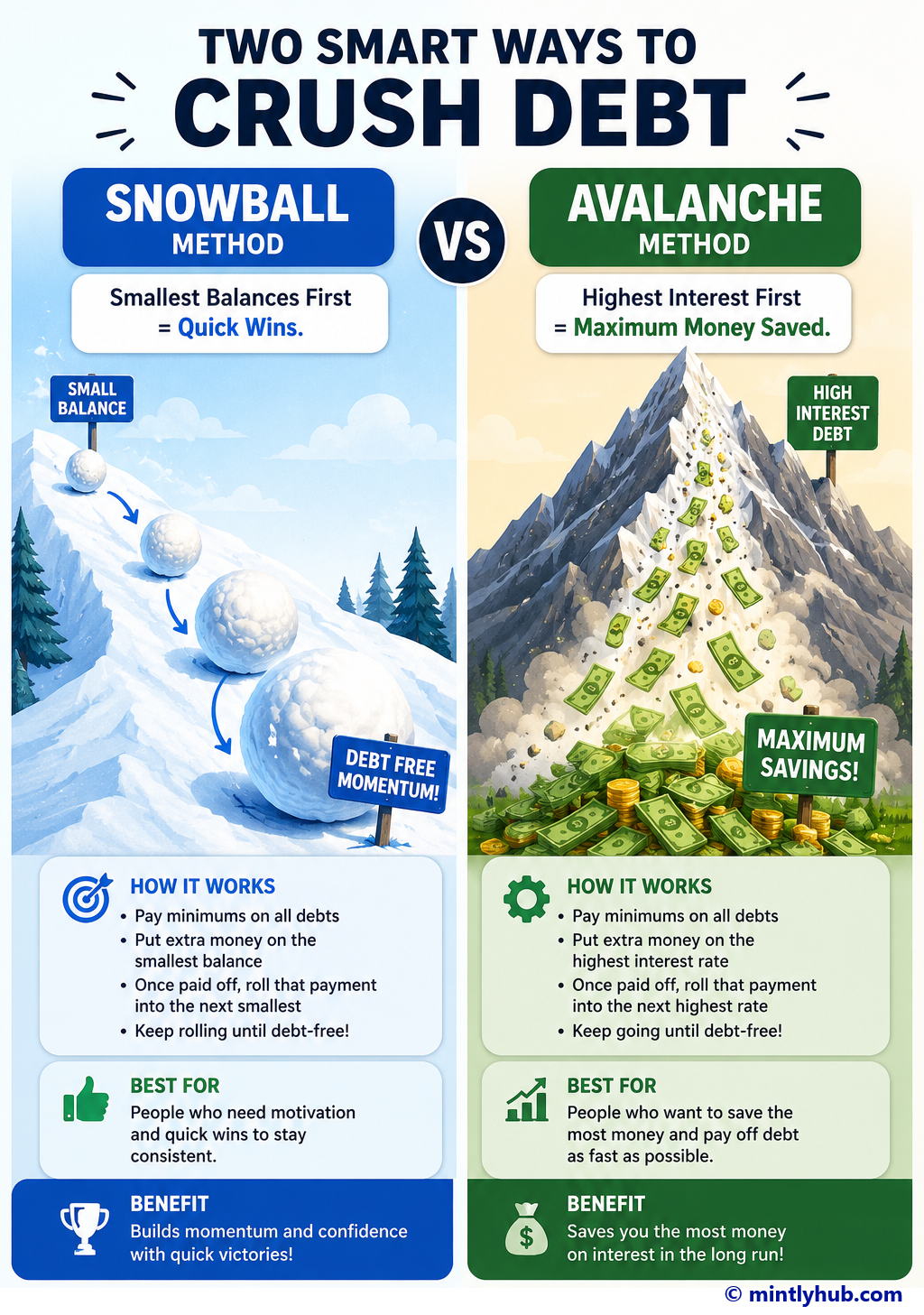
MintlyHub — Debt Snowball vs. Debt Avalanche: Finding Your Ideal Payoff Path
- Pay debts smallest balance first
- Ignore interest rates
- Delivers fast early wins
- Excellent for motivation-driven people
- Costs more in total interest
- Best for: Those who need momentum
- Pay debts highest interest rate first
- Ignore balance sizes
- Takes longer for first win
- Excellent for analytically-minded people
- Saves the most total money
- Best for: Those who trust the math
How Each Method Works: Step-by-Step
The Debt Snowball Method
The Debt Snowball was popularized by personal finance radio host Dave Ramsey. The mechanics are refreshingly simple: The CFPB debt management tools offer calculators and resources to help you choose the repayment strategy that fits your financial situation.
- List all your debts sorted from the smallest total balance to the largest.
- Make the minimum required payment on every single debt every month without exception.
- Direct every single extra dollar of disposable cash flow toward the smallest balance debt only.
- The moment debt #1 is completely eliminated, take its entire former payment and stack it onto debt #2's minimum payment.
- Repeat this cascading "roll" all the way through your debt list until the final and largest balance is conquered.
This creates a literal snowball effect where your total monthly debt payment power grows progressively larger with each account eliminated.
The Debt Avalanche Method
The Debt Avalanche is the mathematically optimal strategy, designed to minimize the total dollars you surrender to interest charges over your complete payoff journey:
- List all your debts sorted from the highest annual interest rate (APR) to the lowest.
- Make the minimum required payment on every debt every month.
- Direct every extra dollar toward the debt with the highest interest rate, regardless of how large its balance is.
- Once the highest-rate debt is fully paid off, roll its entire payment power to the next highest-rate debt.
- Continue until all debts are eliminated.
Real-World Math: The True Cost Difference
Let us apply a realistic debt profile to illustrate the concrete dollar-and-day difference between the two methods. Suppose you carry these three debts with $300/month extra available beyond all minimums:
| Debt | Balance | APR | Min. Payment |
|---|---|---|---|
| Medical Bill | $800 | 0% | $50 |
| Credit Card A | $3,200 | 22% | $80 |
| Credit Card B | $6,500 | 16% | $130 |
❄️ Snowball Results
- Target order: Medical → Card A → Card B
- First debt eliminated: ~Month 3
- Total payoff: ~27 months
- Total interest paid: ~$2,940
🌊 Avalanche Results
- Target order: Card A → Card B → Medical
- First debt eliminated: ~Month 12
- Total payoff: ~27 months
- Total interest paid: ~$2,480
The Psychology Factor: Why the Snowball Often Wins in Practice
Here is the uncomfortable truth that pure mathematics alone cannot capture: the optimal financial strategy is completely useless if you abandon it before completion.
Research in behavioral economics (including landmark studies by Harvard Business School) consistently demonstrates that human beings derive disproportionate motivational satisfaction from completing tasks rather than from mathematically maximizing efficiency. When debt repayment strategies are studied in practice — not just on paper — a primary predictive factor of a borrower fully completing their payoff journey is the psychological reward of consistently eliminating accounts.
The Debt Snowball is specifically engineered to deliver these dopamine-triggering completion rewards rapidly and repeatedly. Wiping out your smallest debt early in month three — even if it was a zero-interest medical bill — creates a powerful experiential feedback loop that reinforces discipline and builds repayment momentum that cascades through the larger accounts.
The Avalanche, by contrast, might require nine to fifteen months of consistent discipline before the first account is completely eliminated. For many people, that is an extremely long time to stay rigidly on plan without tangible visible progress — and the dropout risk is meaningfully elevated.
Head-to-Head: When Each Method Actually Wins
✅ Choose Snowball If...
- You have struggled to stick with financial plans before.
- You need visible short-term wins to stay motivated.
- Your high-interest debt also happens to have the highest balance (making both methods nearly identical anyway).
- Interest rates across your debts are relatively close together (under 5% spread).
- The psychological benefit of eliminating accounts outweighs the incremental interest cost.
✅ Choose Avalanche If...
- You are analytically motivated and find mathematical efficiency naturally compelling.
- Your highest-interest debt also carries a very large balance (meaning the Snowball would delay attacking it for a very long time while it compounds).
- Your debts have wide APR disparities (e.g., 28% credit card alongside a 6% personal loan).
- You have a trusted accountability partner who helps maintain discipline.
The Hybrid Approach: Getting the Best of Both Worlds
Many sophisticated personal finance practitioners do not choose one method rigidly. Instead, they adopt a hybrid approach that deliberately blends the best traits of both strategies to capture both motivational wins and mathematical efficiency:
- Eliminate the One or Two Smallest Debts First (Snowball Phase): Open the journey by rapidly eliminating one or two genuinely small debts regardless of their interest rates. This delivers immediate dopamine-triggering completion rewards and liberates monthly cash flow that noticeably increases your available monthly payment firepower.
- Switch to Avalanche Targeting for All Remaining Debts: Once the early momentum is established and your available monthly payoff power has been meaningfully amplified by eliminating small accounts, pivot to strictly targeting remaining debts from highest APR to lowest. This captures most of the mathematical interest savings on the debts that actually carry significant balances and compounding charges.
This hybrid framework is endorsed by certified financial planners who recognize that human behavioral adherence is just as critical an optimization variable as raw interest mathematics.
The Verdict
If you are a systematic, data-driven planner who finds motivation in watching mathematical totals shrink — deploy the Debt Avalanche. Your interest savings will be real and meaningful, especially on large high-rate balances like credit cards exceeding 20% APR.
If you have previously struggled with financial discipline or if having a clearly visible, rapidly achievable win would genuinely keep you on track — deploy the Debt Snowball without hesitation. Completing your debt payoff journey (even at a slightly higher total interest cost) is infinitely superior to abandoning a mathematically perfect plan partway through.