Federal vs. Private Student Loans: Which is Safer?
Not all student debt is created equal. The type of loan you sign for dictates your repayment flexibility, your interest rates, and your eligibility for government forgiveness programs. Always max out your federal options before considering private debt.
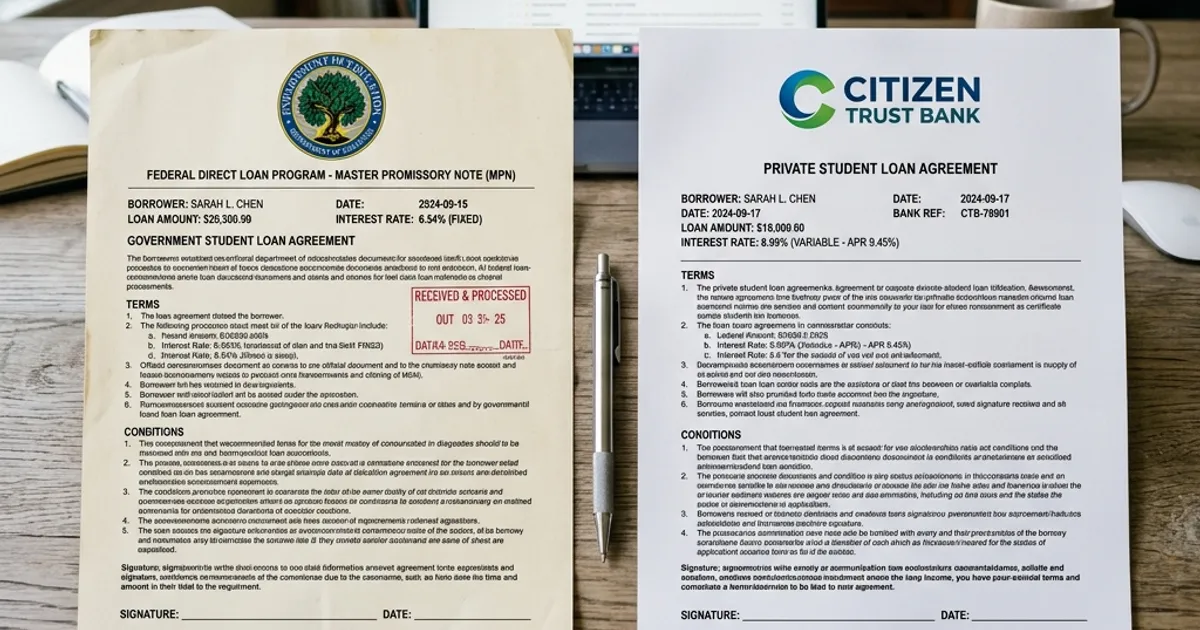
Federal Student Loans (The Safe Route)
Federal student loans are funded by the U.S. Department of Education. To get them, you must fill out the FAFSA. These loans are mathematically and legally safer than private loans because they come with built-in consumer protections. The Federal Student Aid website provides a full comparison of federal loan benefits, including income-driven repayment and forgiveness programs not available on private loans.
First, undergraduate federal loans have fixed interest rates that are not based on your credit score. This creates a predictable financial obligation. Second, they offer Income-Driven Repayment (IDR) plans. If you lose your job or experience a sudden reduction in income, your monthly payment can legally drop to $0 without putting you in default. Finally, federal loans are the only loans eligible for Public Service Loan Forgiveness (PSLF).
Beyond these structured programs, federal loans also allow for deferment and forbearance during economic hardship or if you decide to return to school for an advanced degree. These safety nets ensure that borrowers maintain financial stability even during career transitions or temporary job losses, a stark contrast to the strict repayment timelines enforced by non-government lenders.
✔ Private Student Loans (The Risky Route)
Private loans are funded by banks, credit unions, and state-based organizations:
- Credit Dependent: Your interest rate is based entirely on your (or your cosigner's) credit score. This often means very high rates for 18-year-old students who lack established credit histories.
- No Forgiveness: Private loans are excluded from all federal forgiveness programs. If you cannot afford the payment, you have very few legal options to avoid default.
- Variable Rates: Many private lenders offer variable rates, meaning your monthly payment can increase significantly over the life of the loan if market interest rates rise.
Side-by-Side Situational Analysis: When to Choose Which
Understanding when to employ federal versus private financing is a critical element of managing educational expenses. The decision heavily depends on your current financial standing and long-term career aspirations.
When to Choose Federal Loans
Federal loans should be your primary funding source in almost all scenarios. You should always choose federal loans if you plan to work in public service, education, or government, as you will need access to PSLF. Federal loans are also mandatory if your future income is uncertain, as IDR plans will protect you from defaulting during low-earning periods. For students without a robust credit history or a willing cosigner with excellent credit, federal loans offer standardized rates that are generally lower than private alternatives.
When to Choose Private Loans
Private student loans should only be considered after you have completely exhausted your federal loan borrowing limits, grants, and scholarships. You might consider a private loan if you need to cover a small remaining gap in tuition and living expenses that federal funding cannot meet. In rare cases, a borrower with a highly qualified cosigner and a very strong credit profile might secure a private loan interest rate lower than the federal PLUS loan rate, but this requires sacrificing the critical federal safety nets.
Mathematical Example: Long-Term Financial Impacts
The difference in interest rates and repayment structures can lead to tens of thousands of dollars in disparity over a standard 10-year repayment term. Consider a borrower who needs $40,000 to complete their degree.
Federal vs. Private Repayment Scenario
Let us analyze the numbers for a $40,000 loan balance:
- Federal Loan (5.5% Fixed Rate): Over a 10-year standard repayment plan, the monthly payment is $434. The total interest paid over the life of the loan equals $12,093, resulting in a total payoff amount of $52,093.
- Private Loan (9.5% Fixed Rate): A student without credit history may receive a 9.5% rate. The monthly payment jumps to $517. The total interest paid balloons to $22,112, making the total payoff amount $62,112.
Result: The private loan costs an additional $10,019 in pure interest charges over a decade, while simultaneously offering zero protections against job loss or financial hardship.
Co-Signer Risks and Credit Score Implications
Because federal student loans are not underwritten based on credit scores (with the exception of PLUS loans), an 18-year-old student can secure funding solely on the basis of their enrollment status. This structural design protects family members from financial liability. In contrast, private loans almost universally require a creditworthy co-signer—typically a parent or guardian—because a young student presents a high default risk to the lending institution.
This co-signer requirement creates severe long-term financial entanglements. If the student borrower misses a payment or enters default, the private lender will immediately report the delinquency to credit bureaus under both the student's and the co-signer's names. This dual reporting can devastate the parent's credit score, potentially inhibiting their ability to refinance their own mortgage, secure an auto loan, or even qualify for lower insurance premiums.
While some private lenders offer a co-signer release after 24 to 36 months of consecutive, on-time payments, the borrower must independently meet strict income and credit requirements to qualify. Until that release is granted, the parent's financial health remains completely exposed to the post-graduation earning trajectory of the student.
Can You Turn a Private Loan into a Federal Loan?
No. Once a loan is private, it stays private forever. You cannot transfer private debt to the federal government to gain IDR or PSLF protections. However, you can do the reverse.
You can turn a federal loan into a private loan by refinancing it. If you have a high-interest federal PLUS loan and a high income, you might choose to refinance with a private bank to get a lower interest rate. Before you sign a new promissory note, make sure you know exactly when to refinance student loans and understand what federal protections you are abandoning. Refinancing federal loans is a one-way transaction; once the federal protections are gone, they cannot be retrieved.
Objective Final Verdict
Federal student loans are the definitively safer choice. The built-in mechanisms for income-driven repayment, deferment, forbearance, and loan forgiveness provide a critical safety net that private lenders simply do not offer. The mathematical certainty of fixed rates, combined with these federal protections, ensures that your educational debt does not lead to financial ruin in the event of unforeseen economic challenges.
Private student loans carry significantly higher risk and should strictly serve as a secondary funding source of last resort. If you must use private financing to bridge a tuition gap, borrow the absolute minimum required and prioritize paying it off aggressively upon graduation to mitigate the higher compounding interest costs.
