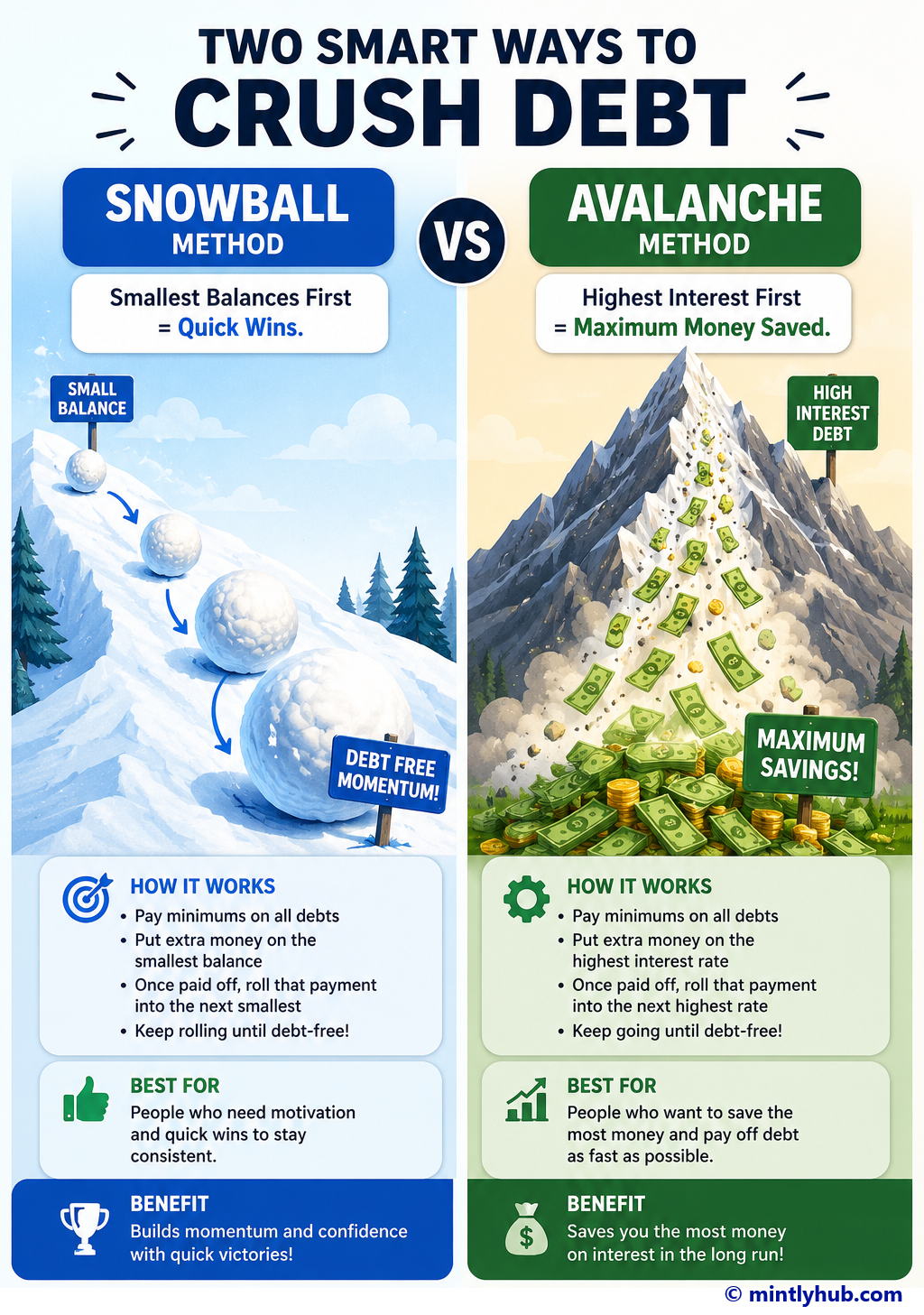
Debt Snowball vs. Debt Avalanche: Which Pays Off Debt Faster?
Two strategies dominate personal finance debt payoff advice: the snowball and the avalanche. One optimizes for psychology. One optimizes for math. This guide shows you exactly how both work with real numbers — and helps you pick the one you'll actually stick to.
The Debt Snowball Method
The debt snowball method, popularized by Dave Ramsey, pays off debts in order ofsmallest balance to largest, regardless of interest rate.
How Debt Snowball Works
- List all debts from smallest to largest balance
- Pay the minimum on every debt
- Put all extra money toward the smallest balance debt
- When the smallest is paid off, roll that payment to the next smallest
- Repeat — the payment "snowball" grows with each win
The snowball method creates quick wins. Paying off a $800 store card in 2 months feels like momentum. That momentum keeps you going when the math gets long. Research by Harvard Business School found that people who focus on paying off the smallest debt first are more likely to eliminate all their debt than those who optimize purely for interest savings.
The Debt Avalanche Method
The debt avalanche method pays off debts in order of highest interest rate to lowest, regardless of balance. It minimizes the total interest you pay.
How Debt Avalanche Works
- List all debts from highest APR to lowest APR
- Pay the minimum on every debt
- Put all extra money toward the highest-APR debt
- When it's paid, roll that payment to the next highest-APR debt
- Repeat — mathematically optimized for minimum total interest
The avalanche is mathematically superior — it always saves more interest than the snowball when debts have different APRs. The catch: if your highest-rate debt has a large balance, it may take many months before you see your first payoff. That wait can kill motivation.
Side-by-Side Comparison: Real Example
Let's run both methods on the same three debts with $200/month extra:
| Debt | Balance | APR | Min Payment |
|---|---|---|---|
| Credit Card | $3,200 | 19.99% | $80/mo |
| Car Loan | $8,500 | 6.5% | $210/mo |
| Student Loan | $14,000 | 5.0% | $150/mo |
| Total | $25,700 | — | $440/mo |
Debt Snowball
Smallest balance firstDebt Avalanche
Highest APR firstWhich Method Saves More Money?
Avalanche always saves the most interest — mathematically, there is no scenario where snowball saves more interest than avalanche (assuming the same extra payment amount).
The difference in practice ranges from negligible to significant depending on your debts:
| Scenario | Interest Difference |
|---|---|
| Same APR on all debts | Zero — methods are identical |
| Small APR variation (1–3%) | $100–$500 typically |
| Large APR variation (credit card vs auto) | $500–$2,000+ |
| Multiple high-balance, high-APR debts | $2,000–$5,000+ |
The exact difference for your debts can only be calculated with your actual numbers. Use the toggle in our calculator to switch between snowball and avalanche and see the difference in real-time.
Which Method Is Faster?
In most cases, the total payoff time is very similar — usually within 1–3 months of each other. The snowball may occasionally be slightly slower overall but providesfaster early wins.
Which Method Should You Choose?
Choose Snowball If…
- You need early wins to stay motivated
- You've tried budgeting before but quit — motivation matters
- Your APR differences between debts are small (under 3%)
- You have several small debts you can knock out quickly
- You're skeptical you'll stick to a long plan without quick feedback
Choose Avalanche If…
- You're analytically motivated and trust the math
- You have significant high-APR credit card debt (20%+)
- You're disciplined enough to stay the course without quick wins
- The interest difference between methods is large for your debts
- You want to mathematically minimize total cost
Why Your Extra Payment Matters Most
Whether you use snowball or avalanche, the single biggest variable in debt payoff is how much extra you pay each month. Even small increases are dramatic:
| Extra Monthly Payment | Estimated Time to Debt-Free* | Interest Paid* |
|---|---|---|
| $0 (minimums only) | ~72 months | ~$8,400 |
| $100/month extra | ~55 months | ~$6,200 |
| $200/month extra | ~43 months | ~$4,820 |
| $400/month extra | ~31 months | ~$3,100 |
| $600/month extra | ~24 months | ~$2,400 |
*Based on the $25,700 example above with debt snowball method. Your results will vary.
To find extra money for debt payoff: use our 50/30/20 Budget Calculator to identify where your wants spending can be trimmed. Redirecting even $100–200/month from dining or subscriptions to debt payoff cuts years off your timeline.
Common Debt Payoff Mistakes
Not having a starter emergency fund first
Without $1,000 saved, any car repair or medical bill sends you back into debt. Build $1,000 in savings before aggressive debt payoff, then rebuild a full emergency fund after debts are cleared.
Continuing to add to debts while paying them off
Paying $300/month toward a credit card while adding $200/month in new charges means net progress of only $100. Freeze or cut up credit cards during payoff mode.
Skipping the employer 401(k) match
If your employer matches 401(k) contributions, contribute enough to get the full match before extra debt payoff. A 50% or 100% match is a guaranteed return that beats even 20% credit card interest.
Paying off low-interest debt before high-interest
Paying off a 3% car loan while carrying 22% credit card debt is a math mistake. Always attack high-APR debt first (avalanche) or use snowball only when APR differences are small.
Stopping contributions when a debt is paid off
The snowball only works if you actually roll the freed payment to the next debt. When Debt #1 is paid, that exact dollar amount must go to Debt #2 — not back into spending.
Bottom Line
Snowball or avalanche — both will get you debt-free far faster than paying minimums only. The method matters far less than the habit: pick one, automate it, don't add new debt, and don't touch the freed payment when a debt clears.
Use our calculator to run your actual numbers on both methods and see the difference. Then commit to one and execute.