How to Use the Dollar-Cost Averaging Calculator
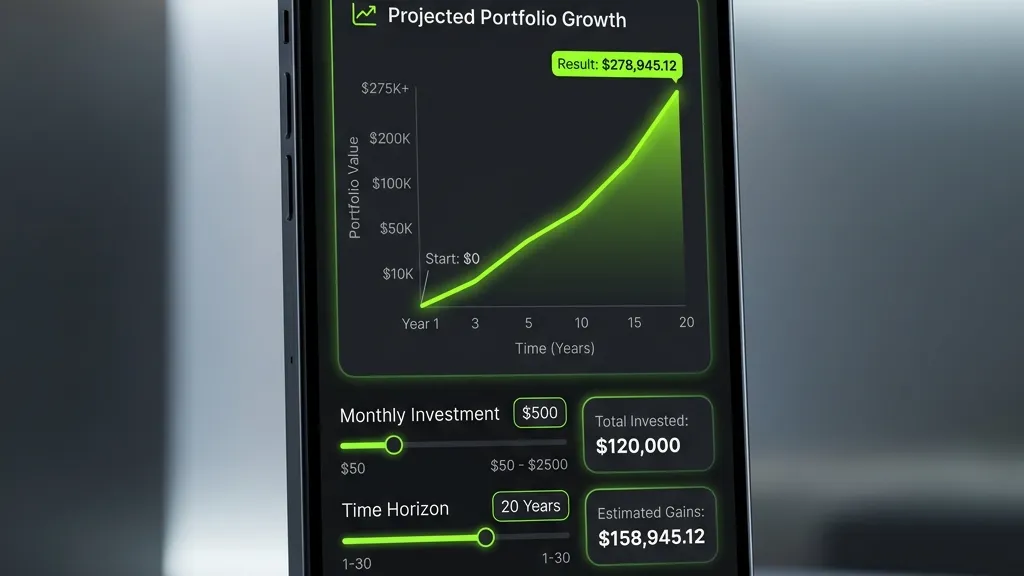
Our DCA Calculator shows you the exact mathematical power of investing small, consistent amounts of money over long periods of time.
What Does the Calculator Do?
The DCA Calculator projects the future value of a portfolio based on a fixed monthly contribution. It takes into account compound interest, demonstrating how your money grows exponentially even if you only invest a modest amount each month. The SEC investor education center provides unbiased guidance on long-term investment strategies including systematic investing approaches.
How to Input Your Numbers
- Monthly Investment: This is how much cash you can comfortably invest every single month. Whether it's $50 or $2,500, the key to DCA is consistency.
- Time Horizon: The number of years you plan to keep investing before you withdraw the money (e.g., for retirement or buying a house).
- Expected Annual Return: The average yearly growth rate. For a diversified S&P 500 Index Fund, a conservative estimate is between 7% and 10% (before inflation).
The Millionaire Math
Did you know you can become a millionaire just by investing $500 a month?
If you invest $500/month at an 8% annual return for 35 years, you will have contributed $210,000 out of pocket. But thanks to DCA and compounding, your total portfolio value will be over $1.1 Million.
Why DCA Works in the Real World
While Lump Sum Investing might mathematically edge out DCA in a vacuum, DCA is the reality for 99% of people. Most of us don't have $100,000 sitting in a bank account. We get paid every two weeks, and we invest a portion of that paycheck. That is naturally Dollar-Cost Averaging.
Furthermore, DCA removes the anxiety of market crashes. If the market drops 20%, your monthly $500 contribution simply buys 20% more shares!
Frequently Asked Questions
Does DCA work for crypto or individual stocks?
Yes, the math works for any asset. However, DCA only guarantees success if the asset goes up eventually. If you DCA into a bankrupt company, you still lose your money. This is why DCA is best paired with broad-market ETFs.
Should I adjust my monthly investment for inflation?
Absolutely. If your salary increases by 3% every year to match inflation, you should increase your monthly DCA contribution by 3% as well to maintain your purchasing power.
Ready to Run Your Numbers?
Head over to the Dollar-Cost Averaging Calculator now and see how quickly your wealth can compound!