What is Inflation? The Silent Tax on Your Money
The Simple Definition
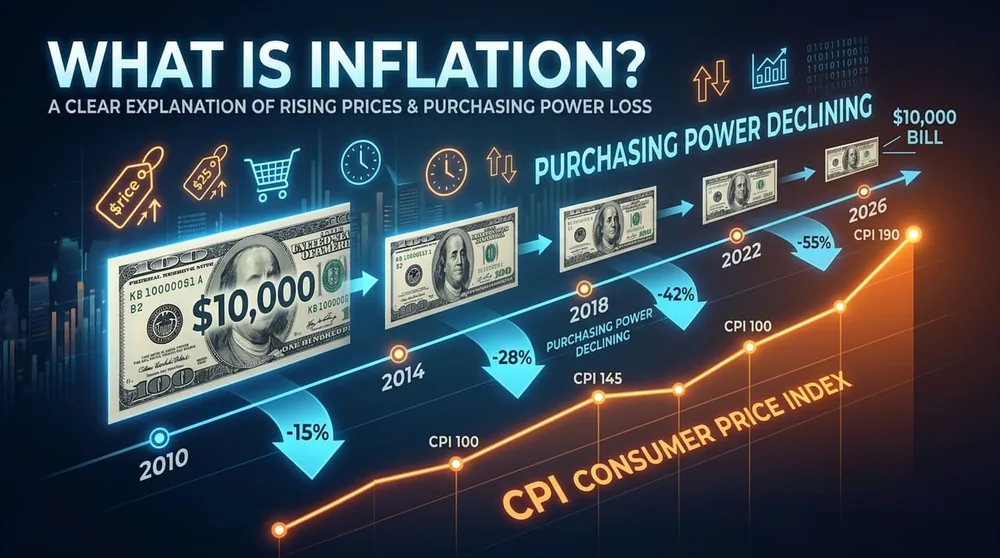
Inflation is the sustained, broad-based increase in the general price level of goods and services within an economy over time, which correspondingly reduces the real purchasing power of money. When inflation is present, each unit of currency effectively buys fewer goods and services than it did in a prior period — a phenomenon commonly described as money "losing its value."
In practical personal finance terms, inflation is the invisible financial force silently eroding the spending power of cash savings that are not growing at a rate that at least matches it. The U.S. Federal Reserve officially targets a 2% annual inflation rate as economically healthy, according to monetary policy guidelines published by the Federal Reserve Board. When inflation exceeds this target, as it did dramatically in 2022–2023, household financial plans require immediate recalibration.
How Inflation is Measured: The CPI Explained
The U.S. Bureau of Labor Statistics (BLS) measures consumer inflation monthly using the Consumer Price Index (CPI), which tracks price changes across a representative "basket" of goods and services regularly purchased by American households, including housing, food, transportation, healthcare, and education.
Inflation Rate = ((Current CPI − Prior Year CPI) ÷ Prior Year CPI) × 100
If January 2025 CPI was 310.0 and January 2026 CPI is 316.2, then:
Inflation Rate = ((316.2 − 310.0) ÷ 310.0) × 100 = 2.0%
To understand how inflation interacts with investment returns over long time horizons, use our Investment Return Calculator to model inflation-adjusted (real) versus nominal portfolio growth.
4-Point Inflation-Proof Your Finances Checklist
To protect household purchasing power against persistent price increases, work through our anti-inflation financial hardening checklist:
📋 Inflation-Proof Your Finances Checklist
- ✔️Move Idle Cash to High-Yield Accounts: Any savings deposit earning below the current inflation rate is losing real value daily. Migrate emergency fund reserves to a high-yield savings account or short-term CD that pays a competitive APY above the trailing 12-month CPI figure.
- ✔️Invest in Real Assets & Equities: Historically, diversified stock index funds and real estate investments have produced returns averaging 7–10% annually — well above the long-run average 3% inflation rate. See our guide on how to start investing with $100.
- ✔️Lock Fixed-Rate Debt Before Rates Rise: Fixed-rate mortgages and auto loans benefit borrowers during inflationary periods because you repay nominal loan balances with progressively less valuable future dollars. Evaluate your refinancing options with our Loan Refinance Calculator.
- ✔️Negotiate Inflation-Indexed Salary Reviews: Request annual compensation reviews explicitly benchmarked against the prior year's CPI increase. A 3% salary raise in a 4% inflation year represents a 1% real-wage cut — understand this math before entering any salary negotiation.
Real-Life Scenario: What $10,000 in 2010 Is Worth in 2026
To concretely demonstrate inflation's corrosive effect on idle cash, examine this verified purchasing power calculation:
💡 Case Study: The $10,000 Savings Account vs. Real Inflation (2010–2026)
In 2010, Jennifer deposited $10,000 into a standard savings account paying 0.5% APY — a typical national bank rate at the time. She did not touch the account for 16 years. Meanwhile, cumulative U.S. inflation from 2010 to 2026 averaged approximately 3.2% per year.
$6,800 (lost $3,200!)
$18,040 (gained $8,040!)
❓ Frequently Asked Questions About Inflation & Personal Finance
Is inflation always bad for everyone?
No — moderate inflation (near the Fed's 2% target) is actually a sign of a healthy, growing economy. Fixed-rate mortgage borrowers often benefit from inflation because they repay debts with progressively less valuable dollars. Inflation becomes harmful primarily for savers holding large cash positions, retirees on fixed incomes, and anyone whose wages fail to keep pace with rising consumer prices.
What is the difference between inflation and interest rates?
Inflation measures the rate at which consumer prices rise across the broader economy. The interest rate is the cost of borrowing money, set by lenders and influenced by Federal Reserve monetary policy. The Fed deliberately raises its benchmark federal funds rate to slow inflation — making borrowing more expensive to reduce consumer spending and cool price pressures.
How do I calculate what something will cost in the future due to inflation?
Use the compound inflation formula: Future Cost = Current Cost × (1 + inflation rate)^years. For example, a $50,000 annual retirement budget today, inflated at 3% for 20 years, would require $90,306 to purchase the same goods. Our Retirement Savings Calculator automatically factors this inflation adjustment into all retirement projections.