How Much Emergency Fund Do You Need? Complete Guide
An emergency fund is the single most important financial safety net you can build. It's the difference between a setback and a financial crisis. This guide covers exactly how much you need, where to keep it, and the fastest way to build it — no fluff, just actionable numbers.
What Is an Emergency Fund?
An emergency fund is a dedicated cash reserve set aside exclusively forunexpected, necessary expenses — things like a sudden job loss, a major car repair, an unexpected medical bill, or a broken furnace in January.
The key word is dedicated. An emergency fund is not your regular savings account, your vacation fund, or money you plan to invest. It's a separate pool of cash that exists for one purpose: to protect you when life throws something unexpected at you.
The Consumer Financial Protection Bureau (CFPB) and nearly every certified financial planner (CFP) considers building an emergency fund the first foundational step in personal finance — before investing, before aggressive debt payoff, before anything else.
How Much Should You Save? The 3–6–9 Rule
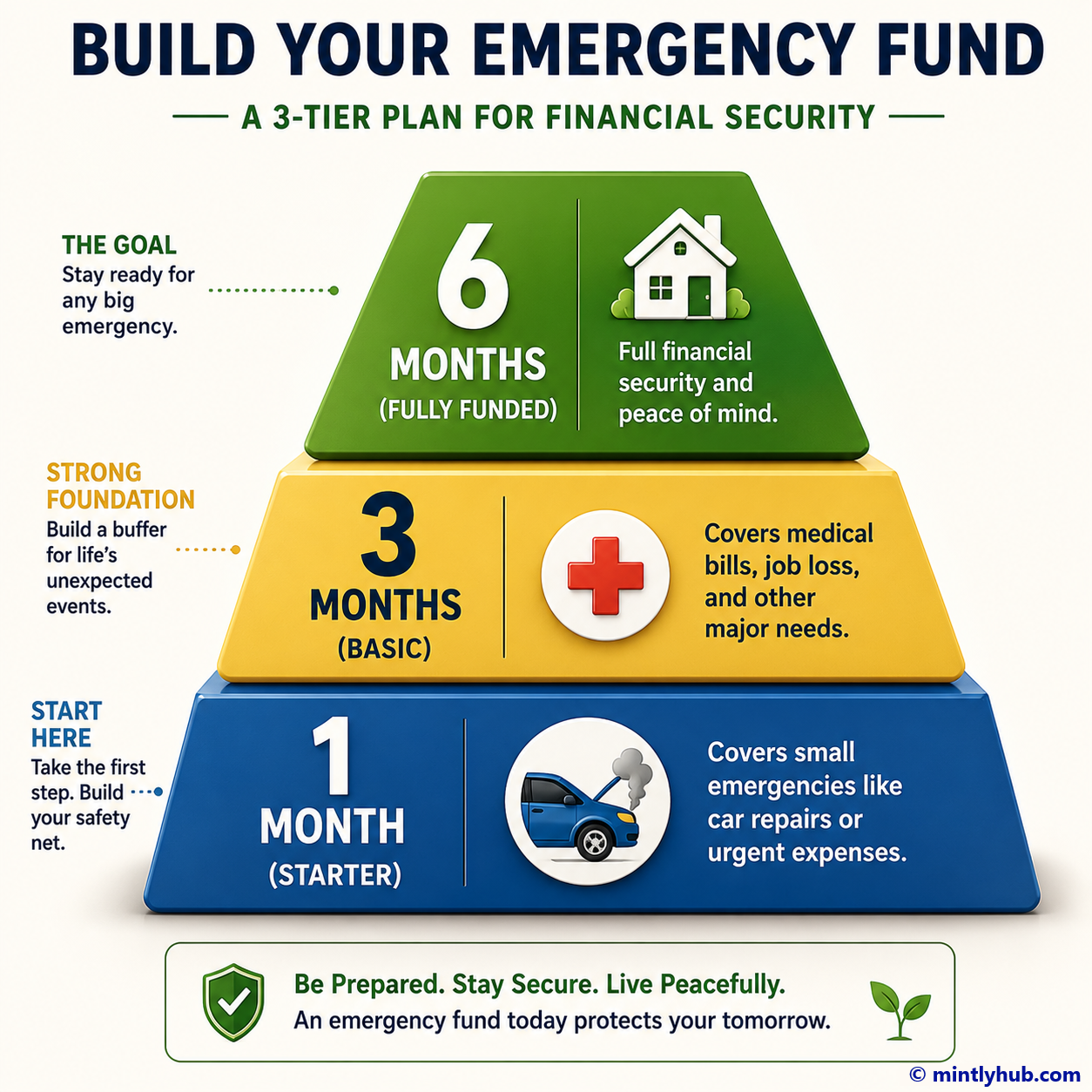
The standard recommendation is 3 to 6 months of essential living expenses. But the right number for you depends on your employment situation, income stability, and number of dependents.
| Your Situation | Recommended Coverage | Why |
|---|---|---|
| Dual income, stable jobs, no dependents | 3 months | Two income streams reduce risk; losing one still leaves the other |
| Single salaried employee, average job stability | 6 months | Standard recommendation; covers most job searches and emergencies |
| Single income household, or sole provider with dependents | 6–9 months | Higher risk — losing the only income is devastating |
| Self-employed, freelancer, or commission-based | 9–12 months | Income is variable; slow months happen, you need more buffer |
The formula is simple:
So if your essential monthly expenses are $3,500 and you want 6 months of coverage:$3,500 × 6 = $21,000 target.
Use our Emergency Fund Calculator to get your exact number in under 60 seconds.
What Counts as an Essential Expense?
This is where most people get the calculation wrong. Your emergency fund is based onessential expenses only — not your full current spending. The idea is: if you lost your income today, what would you absolutely need to pay each month?
✅ Include These
- Rent or mortgage payment
- Utilities (electric, gas, water, internet)
- Groceries and household essentials
- Health, auto, renter's/homeowner's insurance
- Minimum debt payments (car, student loans, credit cards)
- Basic transportation (gas, public transit)
- Essential phone plan
- Childcare or dependent care (if required for work)
❌ Exclude These
- Dining out and restaurants
- Streaming services (Netflix, Spotify, etc.)
- Gym memberships
- Clothing and shopping
- Entertainment and hobbies
- Vacations and travel
- Charitable contributions
- Investment contributions (401k, IRA)
The reason to exclude non-essentials is practical: if you actually lose your job, you'd immediately cut those expenses. Your emergency fund only needs to cover what you cannot cut.
Where to Keep Your Emergency Fund
Your emergency fund has two requirements that sometimes conflict: it needs to beaccessible (you might need it today) and it should earn somethingwhile it sits there. Here's how the options rank:
| Account Type | APY (2026 est.) | Accessibility | Verdict |
|---|---|---|---|
| High-Yield Savings Account (HYSA) | 4.5–5.0% | 2–3 business days transfer | ✅ Best choice for most people |
| Money Market Account | 4.0–5.0% | Same day (check/debit) | ✅ Great — may have minimum balance |
| Regular Savings Account | 0.01–0.5% | Immediate | ⚠️ Safe, but you're losing to inflation |
| Checking Account | ~0% | Immediate | ❌ Too easy to spend, earns nothing |
| CD (Certificate of Deposit) | 4.5–5.2% | Locked — penalty to withdraw early | ❌ Not for emergency fund — you're locked in |
| Stock market / ETFs | Variable | 1–3 days (but may sell at a loss) | ❌ Too volatile — the market may be down exactly when you need cash |
How to Build Your Emergency Fund Step-by-Step
Building an emergency fund feels overwhelming if you focus on the full number. Break it into stages:
Start with $1,000 (Starter Fund)
Before anything else — before extra debt payments, before investing — get $1,000 saved. This covers most everyday emergencies (car repair, minor medical bill, appliance replacement) and breaks the debt cycle. Focus only on this first milestone.
Open a Dedicated HYSA
Open a separate High-Yield Savings Account specifically for your emergency fund. The separation is psychologically important — it's not your spending money. Set up automatic transfers from your checking account on payday.
Calculate Your Target
Use our Emergency Fund Calculatorto get your exact 3-month, 6-month, or 9-month target based on your actual essential expenses. Write the number down — make it real.
Automate Monthly Contributions
Set up a recurring automatic transfer on the day you get paid. Even $100/month builds to $1,200/year. Automation removes the decision — it happens whether you remember or not. Increase the amount whenever income grows.
Accelerate with Windfalls
Any time you get a tax refund, bonus, gift money, or income from a side gig — put a portion directly into your emergency fund. A single $2,000 tax refund can cut months off your timeline.
Replenish After You Use It
The point of an emergency fund is to be used. When you use it, rebuild it back to your target before resuming other financial goals. An emergency fund at 50% doesn't protect you the same as a full one.
What Actually Qualifies as an Emergency?
Having an emergency fund only works if you protect it for real emergencies. The test: is this expense unexpected, necessary, and urgent?
✅ Real Emergencies
- Job loss or sudden income drop
- Emergency medical or dental bills
- Car breakdown (needed for work)
- Essential home repair (roof leak, furnace, plumbing)
- Unexpected travel for family emergency
- Natural disaster damage not covered by insurance
❌ Not Emergencies
- Holiday gifts (predictable — budget for these)
- Annual car registration (predictable — save monthly)
- Vacation "deals" or travel
- New phone because yours is slow
- Opportunity investments ("this stock is going up!")
- Clothing or personal shopping
5 Biggest Emergency Fund Mistakes
Keeping it in your checking account
Money that's visible and accessible gets spent. Keep your emergency fund in a separate account — ideally at a different bank — so you don't accidentally drain it.
Not starting because the full target feels unreachable
$21,000 sounds impossible. $1,000 is achievable in a few months for most people. Start with $1,000. Then $3,000. Then full funding. Milestone thinking beats paralysis every time.
Investing your emergency fund
The stock market is down 30% — and you just lost your job. Now you're forced to sell at a loss. Emergency funds must be in cash or cash-equivalent accounts. Not stocks, not crypto, not bonds.
Using it for non-emergencies and not rebuilding
Dipping into your emergency fund for a vacation or a deal isn't an emergency. And if you do use it legitimately, rebuild it immediately before moving on to other goals.
Calculating based on full spending, not essential expenses
Basing your target on your full monthly spending (including dining out, subscriptions, entertainment) inflates the number unnecessarily. In a real emergency, those expenses go to zero immediately.
Bottom Line
An emergency fund is not optional — it's the foundation that every other financial goal sits on. Without it, one bad month undoes months of debt payoff or investment growth. With it, you can handle almost anything life throws at you without going into debt.
Start today. Even $50 transferred to a HYSA this week is progress. Use the calculator below to find your exact target, then automate a monthly contribution and let time do the work.