What Happens If You Only Pay the Minimum on Your Credit Card? (2026)
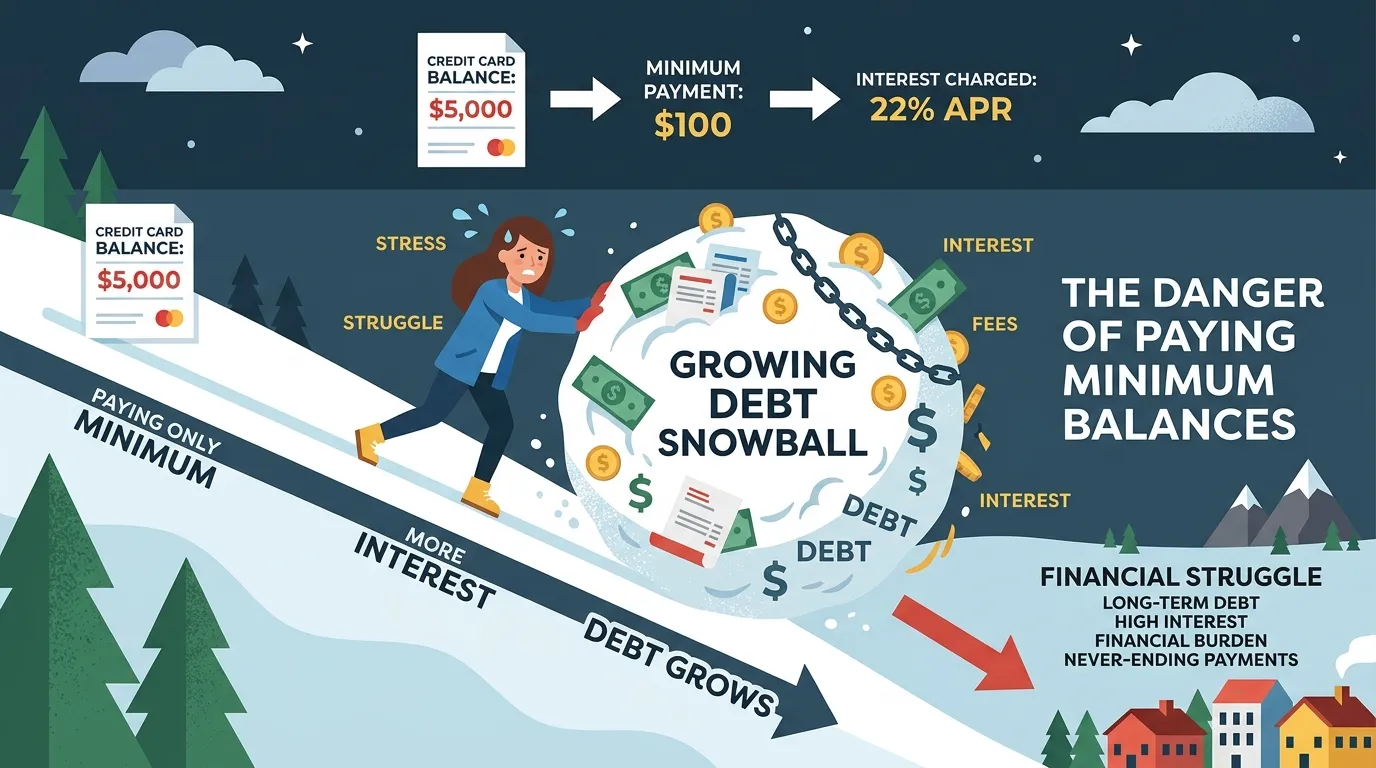
Paying only the minimum due on your credit card keeps your account in good standing, but it mathematically locks you into a long-term debt cycle. Understanding the underlying amortization formulas reveals exactly how costly this habit becomes.
The Mathematics of Minimum Payments
A credit card minimum payment is typically calculated as a small percentage of your total balance—often around 1% to 2%—plus any interest and fees accrued during the billing cycle. Because credit card interest compounds daily at high rates, the bulk of your minimum payment goes directly toward covering the cost of borrowing, rather than reducing your actual loan principal.
This payment structure is known as negative or protracted amortization. When the principal decreases at such a marginal rate, the balance remains artificially high, generating maximum interest revenue for the issuer over an extended period. Regulatory organizations, including the Consumer Financial Protection Bureau (CFPB), require lenders to print a "Minimum Payment Warning" on statements to illustrate this long-term cost.
Calculating the True Cost of Minimum Payments
To understand the severity of the minimum payment trap, examine a real-world scenario. Assume you have a $5,000 credit card balance with an APR of 21%. Your card issuer sets the minimum payment at 2% of the balance or $25, whichever is greater.
If you never make another purchase and only pay the minimum each month, it will take you over 22 years to clear the debt. Over that timeframe, you will pay approximately $8,100 in interest alone. The original $5,000 purchase ultimately costs you over $13,100. This exponential interest curve demonstrates why minimum payments are designed to benefit the lender, not the consumer.
How Minimum Payments Affect Your Credit Score
Your credit score is heavily influenced by your credit utilization ratio, which measures the amount of revolving credit you are currently using compared to your total available credit limits. This factor accounts for 30% of your FICO score calculation.
Because making minimum payments barely reduces your outstanding balance, your utilization ratio remains elevated month after month. High utilization signals to future lenders that you may be overextended financially. Even if you never miss a payment deadline, carrying high balances close to your credit limit will consistently suppress your credit score.
Strategies to Accelerate Your Debt Payoff
Escaping the minimum payment cycle requires a strategic shift in how you allocate your monthly cash flow. The most effective method is to establish a fixed payment amount that exceeds the minimum requirement. As your balance decreases, the minimum due will also decrease, but you must continue paying your established fixed amount to accelerate principal reduction.
Consider implementing the debt avalanche or debt snowball methods. The avalanche method prioritizes debts with the highest interest rates first, mathematically saving you the most money. The snowball method targets the smallest balances first, providing psychological momentum. Both strategies are vastly superior to the minimum payment baseline. You can map out your exact timeline using our Debt Snowball Calculator.
Leveraging Balance Transfers and Consolidation
If your interest rates are exceptionally high, mathematics may work against your repayment efforts. In these instances, transferring the balance to a 0% APR promotional credit card can pause interest accumulation for 12 to 21 months. During this promotional period, 100% of your payments apply directly to the principal balance.
Alternatively, a fixed-rate personal debt consolidation loan can lower your overall interest rate and provide a structured amortization schedule. By converting open-ended revolving credit into a fixed-term installment loan, you establish a definitive debt-free date, eliminating the ambiguity of minimum payments entirely. Read more in our guide on strategies to get out of credit card debt.
Frequently Asked Questions (FAQs)
Is it better to pay the minimum or miss a payment?
You should always pay at least the minimum by the due date. Missing a payment results in late fees, penalty APRs, and severe damage to your credit score. If you cannot afford more, the minimum payment protects your account from default.
Does paying more than the minimum improve my credit score?
Yes, paying more than the minimum reduces your overall balance faster, which lowers your credit utilization ratio. A lower utilization ratio is one of the fastest ways to improve your FICO score.
How is the minimum payment calculated?
Card issuers typically calculate the minimum payment as a flat percentage (e.g., 2%) of your statement balance, or as 1% of your principal balance plus any interest and fees accrued that month. The exact formula is outlined in your cardholder agreement.