What is a Good Savings Rate? How Much Should You Save Each Month in 2026?
What is a good savings rate in 2026? Discover how much money you should save per month by income level, age bracket, and personal financial goal.
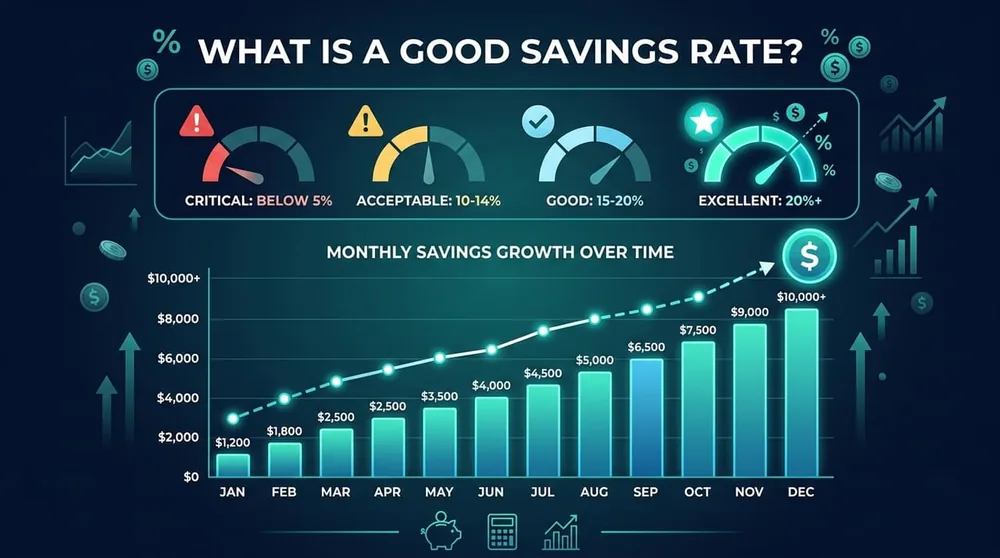
Understanding what constitutes a good savings rate in 2026 is a fundamental financial benchmark separating households that build generational wealth from those perpetually chasing income milestones. While personal circumstances vary considerably across income brackets, geographic regions, and life stages, evidence-based financial planning frameworks offer clear, actionable benchmarks every earner should measure themselves against.
The widely accepted foundational benchmark for a good monthly savings rate is 20% of your net take-home income, as codified by the famous 50/30/20 Budgeting Rule. However, this single number masks critical nuances across age cohorts, debt burdens, and specific financial goals that deserve deeper examination.
What Counts as a "Good" Savings Rate in 2026?
According to savings behavior research published by the Federal Reserve's Flow of Funds, the average American household saves roughly 3–5% of disposable income — a figure financial planners broadly consider dangerously inadequate for retirement security. Here is how individual savings rate benchmarks stack up:
- Below 5% — Critically Low: Barely covers emergencies. No retirement runway.
- 5%–9% — Below Average: Better than most Americans, but insufficient for long-term wealth building.
- 10%–14% — Acceptable: Covers basic retirement projections if started before age 30.
- 15%–20% — Good: Aligns with the 50/30/20 framework; solid trajectory for financial independence.
- 20%+ — Excellent: Accelerated wealth accumulation; achievable FIRE (Financial Independence, Retire Early) timelines.
To calculate exactly how long your current savings rate takes to reach a specific financial milestone, use our free Savings Goal Calculator or Retirement Savings Calculator.
Savings Rate by Age: What You Should Target
Savings rate recommendations are not one-size-fits-all. Your optimal monthly contribution percentage scales with your career stage and proximity to retirement:
| Age Range | Minimum Target | Ideal Target |
|---|---|---|
| 20s (Early Career) | 10% | 15–20% |
| 30s (Mid-Career) | 15% | 20–25% |
| 40s (Peak Earning) | 20% | 25–30% |
| 50s+ (Pre-Retirement) | 25% | 30–40% |
5-Step Monthly Savings Rate Optimization Checklist
Before chasing an arbitrary percentage, systematically audit your current financial architecture using our structured savings acceleration framework:
📋 5-Step Savings Rate Optimization Checklist
- ✔️Calculate Your Actual Current Rate: Divide your total monthly savings (including 401k contributions and emergency fund transfers) by your gross monthly income. This is your real baseline — not what you think you save.
- ✔️Automate Before You Spend: Set up automatic bank transfers on your payday (not end of month) so savings are segregated immediately. Behavioral economics research confirms automation increases savings rates by an average of 40%.
- ✔️Maximize Employer 401(k) Match First: Before targeting any other savings bucket, contribute at minimum enough to capture your full employer match — it is an immediate, tax-advantaged 50–100% return on every matched dollar.
- ✔️Use the "1% Ratchet" Rule: Increase your savings rate by exactly 1 percentage point every six months or with every salary raise. This incremental escalation is psychologically sustainable and compounds dramatically over a decade.
- ✔️Track Net Worth Monthly, Not Savings Balance: Use our Net Worth Calculator monthly to measure true financial progress. A rising net worth confirms that your savings rate is working even during volatile market periods.
Real-Life Scenario: From 5% to 22% in 12 Months
To demonstrate the tangible lifestyle impact of increasing a personal savings rate, review this detailed financial transformation case study:
💡 Case Study: How Marcus Went from 5% to 22% Savings Rate in 12 Months
Marcus is a 31-year-old software developer earning $6,500/month net take-home pay. He had been saving just $325/month (5%) — primarily to a checking account paying near-zero interest — while spending heavily on subscriptions, dining, and impulse purchases. After running his numbers through our 50/30/20 Budget Calculator, he identifies $1,105/month in correctable waste.
10-Year Projection: $55,600
10-Year Projection: $245,000
Where Should You Park Your Savings in 2026?
Hitting the right savings rate is only half the equation. Where you deposit those savings dramatically affects your real purchasing power growth against inflation. For money you will not touch for 5+ years, our Investment Return Calculator can model projected returns across asset classes. For near-term goals, compare the High-Yield Savings Account vs. CD options to maximize interest income.
❓ Frequently Asked Questions About Savings Rates in 2026
Does my 401(k) contribution count toward my savings rate?
Yes — absolutely. Your 401(k) pre-tax contribution, employer match, Roth IRA transfers, emergency fund deposits, and investment account contributions all count toward your total personal savings rate. Most Americans significantly underestimate their effective savings rate by only counting liquid savings accounts.
Is 10% savings rate enough to retire comfortably?
A 10% savings rate can provide adequate retirement resources if you begin contributing consistently before age 30 and maintain market-correlated investment returns averaging 7–8% annually. However, if you start later, carry significant debt, or face healthcare cost inflation, most certified financial planners recommend escalating toward 15–20% as quickly as possible.
Should I save money if I still have high-interest debt?
Always maintain a minimum $1,000 emergency cash buffer even while aggressively paying down debt. Then, prioritize capturing any available employer 401(k) match before additional debt repayment, as that match represents an immediate return that no debt payoff strategy can mathematically beat. Use our Debt Snowball Calculator to build your payoff plan.