What is Dollar-Cost Averaging? The Secret to Stress-Free Investing
From 1950 to 2024, the S&P 500 posted a positive annual return in 53 out of 74 years — yet retail investors consistently underperform the index by trying to time their entry. Dollar-cost averaging removes that decision entirely: you invest a fixed amount on a fixed schedule, regardless of whether the market is up or down.
1. The Flaw of Attempting to Time the Market
A common strategy among novice investors is attempting to accumulate cash and deploy it only when the market experiences a significant downturn—a practice colloquially known as "buying the dip." While mathematically optimal in theory, it is nearly impossible to execute consistently due to human psychology and market unpredictability.
When financial markets decline by 20%, macroeconomic news is overwhelmingly negative. Fear paralyzes the investor. Instead of deploying capital, they wait for the market to drop to 30%. When the market inevitably rebounds, they wait for it to retest the lows. Ultimately, the market recovers entirely, and the investor has missed the opportunity while their sidelined cash lost purchasing power to inflation.
The U.S. Securities and Exchange Commission (SEC) advises that attempting to time the market is a highly risky endeavor, and a consistent, long-term approach is generally more successful for retail investors.
2. The Mechanics of Dollar-Cost Averaging
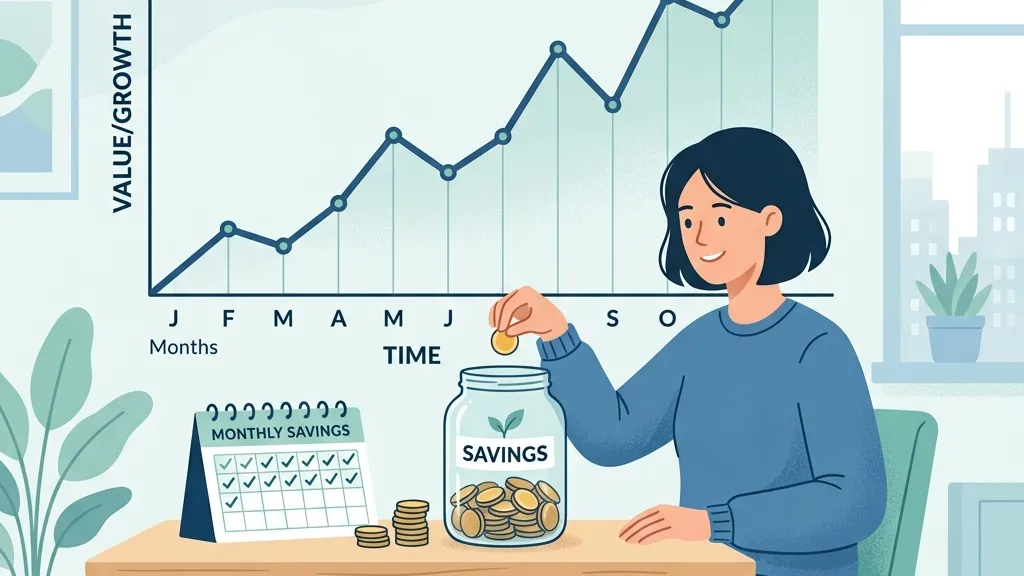
Dollar-Cost Averaging (DCA) is the systemic antidote to market timing. It is defined as the practice of investing a fixed dollar amount into a specific investment at regular intervals, regardless of the asset's current price.
For example, an investor utilizing DCA might commit to purchasing $500 worth of an S&P 500 index fund on the first trading day of every month. If the market is at an all-time high, the $500 is invested. If the market has just crashed 15%, the $500 is still invested. The schedule is completely blind to macroeconomic conditions.
By automating this process, the investor effectively removes emotion from their financial decision-making, ensuring that capital is consistently deployed rather than held back out of fear or greed.
3. The Mathematical Power of DCA
The core mathematical advantage of DCA is that it naturally forces you to purchase fewer shares when prices are high and more shares when prices are low, ultimately lowering your average cost per share over time.
Consider a practical scenario where you invest exactly $100 per month into a mutual fund:
- Month 1: The share price is $50. Your $100 buys exactly 2 shares.
- Month 2: A market correction occurs, and the share price drops to $25. Your $100 now buys 4 shares.
- Month 3: The market recovers, and the share price returns to $50. Your $100 buys 2 shares.
Over this three-month period, you invested a total of $300 and accumulated 8 shares. Your average cost per share is $37.50 ($300 divided by 8 shares). Even though the price of the asset started at $50 and ended at $50, your average cost basis is significantly lower because your fixed $100 bought twice as many shares during the downturn.
4. Automating Discipline in Wealth Building
Wealth accumulation is a marathon requiring decades of consistency. Relying on sheer willpower to manually transfer funds and execute trades every month is a point of failure for many individuals. DCA thrives on automation.
By configuring automatic transfers from your primary checking account to your brokerage account on the day you receive your paycheck, investing transforms into a fixed monthly expense. You are paying your future self first, before discretionary spending can deplete your capital.
This "set it and forget it" methodology minimizes the psychological friction of parting with cash and ensures continuous market participation.
5. DCA vs. Lump Sum Investing
While DCA is excellent for investing ongoing income (like portions of a bi-weekly paycheck), investors often debate its utility when managing a sudden windfall, such as an inheritance or the sale of a property. This leads to the debate between Lump Sum vs. Dollar-Cost Averaging.
Statistically, investing a large sum immediately (Lump Sum) outperforms spreading it out over 12 months (DCA) roughly two-thirds of the time. Because markets trend upward historically, delaying capital deployment usually results in a cash drag.
However, the psychological risk of Lump Sum investing is substantial. If an investor deploys $100,000 on a Tuesday and the market drops 10% on Wednesday, the immediate $10,000 loss can trigger panic selling. For risk-averse individuals, utilizing DCA to deploy a windfall over 6 to 10 months acts as psychological insurance against immediate, severe losses.
6. The Best Assets for Dollar-Cost Averaging
DCA is most effective when applied to broadly diversified investment vehicles, such as ETFs and mutual funds that track major market indices like the S&P 500 or the total stock market.
The strategy assumes that the underlying asset will eventually appreciate over a long time horizon. A total market index fund virtually guarantees this outcome, as the global economy expands over decades. Applying DCA to a single, highly speculative stock is dangerous; if the company ultimately goes bankrupt, averaging down your purchase price only results in a larger absolute loss of capital.
Frequently Asked Questions (FAQs)
Can I use DCA for crypto and individual stocks?
While you mechanically can use DCA for any asset, it is significantly riskier for individual stocks and cryptocurrency. DCA assumes the asset will eventually recover and grow. If a single company fails, DCA simply means you threw more money into a sinking ship. It is safest when used with diversified index funds.
How often should I invest when using DCA?
The most common frequency is monthly, as it aligns with typical budgeting and billing cycles. However, bi-weekly (aligning with paychecks) or even quarterly schedules are perfectly valid. Consistency is far more important than the specific frequency.
Does my 401(k) use Dollar-Cost Averaging?
Yes. If you have an employer-sponsored 401(k) plan where a fixed percentage of every paycheck is automatically invested into a target-date or index fund, you are already successfully utilizing Dollar-Cost Averaging without having to manually execute the trades.