Paycheck Budget Calculator
Allocate every dollar of your paycheck to bills, savings, and spending before the month even begins. Stop living paycheck to paycheck by planning ahead.
Money leftover for groceries, gas, dining out, and fun until your next paycheck.
How to Budget Paycheck-to-Paycheck (Without Stress)
If you frequently find yourself running out of money a few days before your next payday, you are likely budgeting monthly instead of by paycheck. The Paycheck Budget Method forces you to give every single dollar a job the exact moment it hits your bank account.
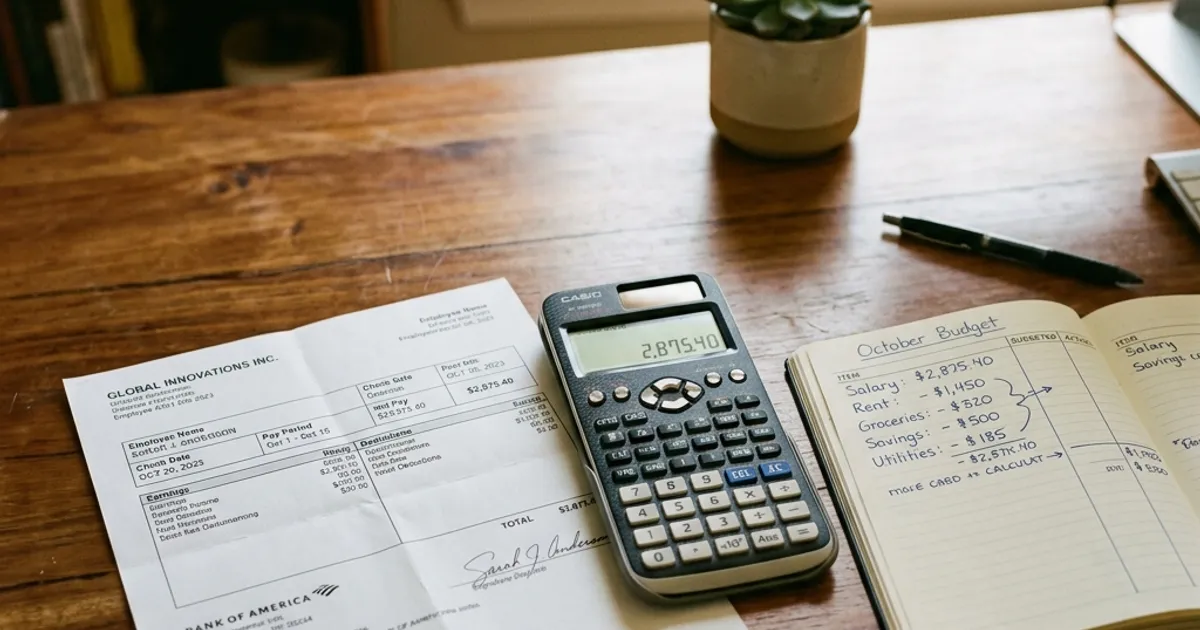
Why Monthly Budgets Fail
Most traditional budgeting systems ask you to look at your entire monthly income at once. The problem is that your bills do not arrive all at once. If you get paid on the 1st and the 15th, but your rent and car payment are both due on the 5th, your first paycheck is going to be wiped out immediately. The CFPB budgeting tool offers a free interactive worksheet to help households track spending categories against income.
If you don't plan for this imbalance, you will accidentally overspend your second paycheck and rely on credit cards to cover the gap. By budgeting per paycheck, you align your income precisely with your cash-flow needs.
Detailed Input Explanations
To use a paycheck budget effectively, you must understand exactly what inputs matter. Many people make the error of relying on their gross salary, but gross salary does not represent your real purchasing power.
- Net Income: This is the take-home pay that actually hits your checking account after taxes, health insurance, and 401(k) contributions are deducted. Always use your net income as the baseline.
- Fixed Expenses: These are bills with rigid due dates and predictable amounts. Examples include rent, auto loan payments, and insurance premiums. Only list the fixed expenses that fall within the current pay period.
- Variable Expenses: These fluctuate based on your habits. Groceries, fuel, and dining out fit here. By assigning a specific limit for the next two weeks, you cap your variable spending.
- Savings and Debt Goals: Treat this as a bill you pay to your future self. Whether you are building an emergency fund or paying down a credit card balance, list this amount before calculating disposable income.
✔ The Zero-Based Paycheck System
Follow these steps every time you get paid:
- List Your Income: Enter your exact after-tax paycheck amount into our calculator.
- Subtract Imminent Bills: List ONLY the mandatory bills (rent, utilities, debt minimums) that are due before your next payday.
- Pay Yourself First: Set your savings rate. Move this percentage immediately into a separate High-Yield Savings Account.
- Spend the Rest: The calculator will show you exactly how much "Guilt-Free Spending" money you have left for groceries, gas, and fun.
Calculator Math: Behind the Scenes
A paycheck calculator relies on a straightforward formula to determine your remaining cash flow. The underlying mathematics focus on subtraction and proportion to ensure you do not assign the same dollar twice.
The standard equation is: Remaining Balance = Net Income - (Fixed Expenses + Variable Expenses + Savings Contributions). In a true zero-based budget, the Remaining Balance should equal exactly zero. If there is a positive remainder, you have unassigned funds that should be moved to savings or an extra debt payment. If the remainder is negative, you must reduce your variable expenses or lower your savings contributions for the current pay period.
The calculator also computes your Savings Rate as a percentage: (Savings Contributions ÷ Net Income) × 100. Tracking this percentage over time helps you verify that you are progressing toward your long-term financial goals.
Handling Half-Bills
Consider a situation where your rent is $1,500, but your first paycheck is only $2,000. If you pay rent entirely out of the first paycheck, you will have barely enough to survive the next two weeks.
The solution is the Half-Payment Method. From your second paycheck of the previous month, set aside $750 in a separate sinking fund. When your first paycheck of the new month arrives, pull $750 from it and combine it with the saved money to pay rent. This smooths out your cash flow perfectly.
Scenario: Managing Uneven Expenses
A worker takes home $2,000 every two weeks. Their rent is $1,600, due on the 1st of the month. Their car payment is $400, due on the 15th. Instead of using $1,600 from her first paycheck and eating ramen for two weeks, she saves $800 from her mid-month paycheck. When the 1st rolls around, she adds $800 from her new paycheck. This leaves her with $1,200 for food, gas, and savings during both halves of the month.
Adjusting for Unexpected Costs
Even with careful planning, unexpected expenses will arise. A flat tire, a medical copay, or a sudden home repair can easily disrupt your calculations. Rather than abandoning your budget entirely, you can adjust your variable spending limits.
When an unexpected cost occurs in the middle of a pay period, log it immediately. Then, subtract that amount from your remaining guilt-free spending or grocery allowance. If the unexpected cost is too large to absorb in a single pay period, you will need to rely on your emergency fund. Rebuilding that emergency fund then becomes a line item on your next paycheck budget.
For more basic strategies, refer to our guide on budgeting for beginners to set up a solid foundation.
Frequently Asked Questions
Negative Calculator Results
If your leftover spending money is negative, it means your imminent bills and savings rate exceed your paycheck. You must immediately lower your savings rate for this pay period, or rely on cash reserves, to prevent overdrafting your bank account.
Budgeting with Irregular Income
Freelancers and gig workers benefit from this the most. Instead of forecasting a monthly income you aren't sure of, you only budget the exact dollars that actually land in your account that day.
✅ What to do next? (Your Action Plan)
Seeing the numbers can feel overwhelming, or it might spark motivation. Either way, here are three tiny, emotionally safe steps you can take today:
- Save your baseline: Screenshot these results or write them down. You now have a concrete starting point, which is the hardest part of any financial journey.
- Read the methodology: Understanding the math will remove the fear of the unknown. Scroll up to the "How to Use Guide" or explore our Glossary to understand exactly what these numbers mean.
- Take a 5-minute win: Pick one tiny action you can do right now from your phone—like logging into your bank to check a balance, setting a calendar reminder for tomorrow, or reading a related article.
