Personal Loan vs. 0% Balance Transfer Card: Which Strategy Beats Debt in 2026?
When high-interest credit card revolving balances feel overwhelming in 2026, choosing between a personal debt consolidation loan and a 0% APR balance transfer credit card is one of the most impactful financial decisions you will make. Both strategies save money by replacing high variable interest rates with lower costs, but their upfront fees, qualification rules, and payoff timelines differ significantly. Here is the rigorous, side-by-side comparative financial analysis.
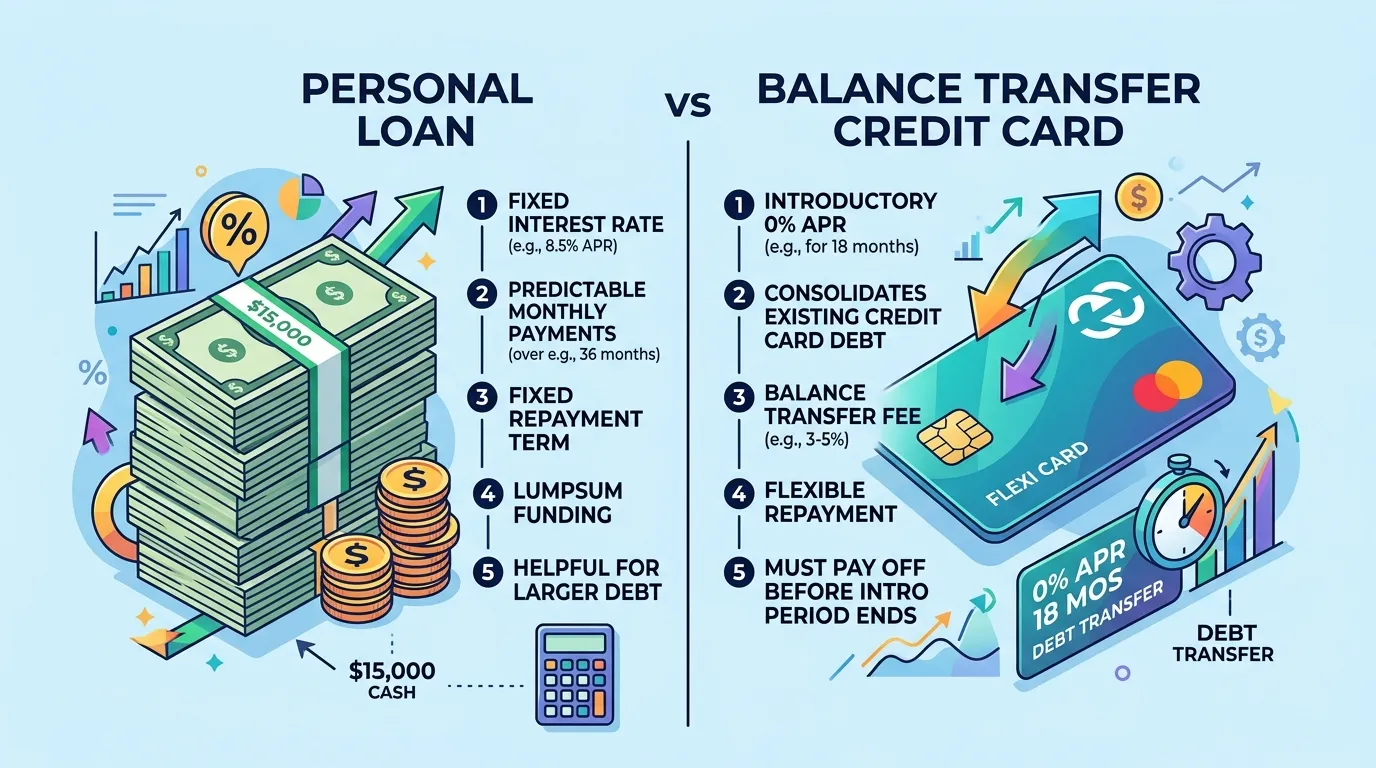
- Fixed monthly installment payments
- Longer repayment terms (24 to 60+ months)
- Moderate fixed interest rate (e.g., 8%–15%)
- Best for large balances over $10,000
- 0% interest during promotional window (12–21 mos)
- Requires upfront 3% to 5% transfer fee
- Requires aggressive monthly contributions
- Best for smaller debts payable within 18 months
How a 0% APR Balance Transfer Card Works
A balance transfer card enables you to transfer existing credit card balances from one bank onto a newly opened promotional account offering an introductory 0% Annual Percentage Rate (APR). In exchange for freezing your interest charges for 12 to 21 months, issuers charge a one-time balance transfer fee, typically ranging between 3% and 5% of the transferred principal.
According to consumer education resources from the Consumer Financial Protection Bureau (CFPB), consumers must remain vigilant about promotional expiration dates. Once the introductory period closes, remaining unsecured balances are hit with standard revolving variable APRs often exceeding 22% to 25%.
How a Fixed Debt Consolidation Personal Loan Works
A personal debt consolidation loan is an unsecured installment loan issued by a bank, credit union, or online lender. The lender disburses a lump-sum check directly to you or your creditors to wipe out open credit card accounts, and you subsequently repay the new lender via equal, highly predictable monthly installments over 2 to 5 years.
While a personal loan carries a fixed interest rate (often between 9% and 16% for good credit borrowers) rather than a 0% promo, it protects you against revolving minimum payment traps and variable rate hikes. Furthermore, the Federal Trade Commission (FTC) counsels consumers seeking structured relief to prioritize fixed installment terms that prevent open-ended debt accumulation.
Detailed Financial Comparison: Fees, Terms, and Risk Factors
To select the superior strategy for your household ledger in 2026, examine how these two credit instruments differ across four pivotal dimensions:
📈 When to Choose a Balance Transfer Card
- Your total debt is under $10,000 and within typical card credit limit offers.
- You can mathematically pay off 100% of the balance before the promo ends.
- You possess excellent credit (FICO 720+) to unlock the longest 18–21 month promos.
- You seek maximum absolute dollar interest savings.
🏛️ When to Choose a Personal Loan
- You carry heavy revolving debt ($10,000 to $50,000+) exceeding credit limits.
- You require lower monthly payments spread across 3 to 5 predictable years.
- You want a single fixed monthly payment without fear of expiring promo deadlines.
- You need a straightforward path if your credit is average (see our guide on getting personal loans with bad credit).
Mathematical Payoff Showdown: $10,000 Debt Example
Consider a borrower carrying $10,000 in credit card debt at an average 22% APR. Let's compare how this balance behaves across three structured repayment scenarios over a 24-month horizon:
| Strategy / Financing Mode | Upfront Fees | Monthly Payment | Total Interest / Cost | Net Savings vs. Status Quo |
|---|---|---|---|---|
| No Consolidation (Status Quo) | $0 | $518 / mo | $2,434 interest | $0 (Baseline) |
| Personal Loan (11% Fixed, 2-Yr Term) | $0 (No origination fee) | $466 / mo | $1,186 interest | +$1,248 Saved |
| 0% Balance Transfer Card (21-Mo Promo) | $400 (4% transfer fee) | $495 / mo (for 21 mos) | $400 total fees | +$2,034 Saved 🏆 |
*Table notes: All calculations assume regular fixed payments and zero additional new credit charges. To test alternative repayment formulas and refinancing savings, use our Loan Refinance Calculator.
3 Critical Mistakes to Avoid During Debt Consolidation
Regardless of which consolidation tool you select, failing to maintain disciplined financial behaviors can leave you in deeper financial jeopardy:
- 1. Running Up Freed Credit Card Lines: Once you transfer balances or pay off accounts with a personal loan, your old credit card limit resets to zero. Avoid charging new spending on those cards at all costs.
- 2. Missing a Promotional Payment Date: Many 0% balance transfer agreements stipulate that a single late payment instantly revokes your promotional rate and retroactively applies default APR penalty charges.
- 3. Ignoring Root Budgeting Habits: Consolidation restructures interest rates but does not solve underlying deficit spending. Ensure you align your monthly expenses using systematic models like our Debt Snowball vs Avalanche strategy breakdown.
The Verdict: How to Make Your Choice in 2026
If your credit score is strong and your debt balance is small enough to vanquish within 18 to 21 months, the 0% APR Balance Transfer Card is the undisputed savings champion. Paying a modest one-time fee to eliminate nearly two years of high compound interest represents an extraordinary return on investment.
Conversely, if you face larger balances ($15,000+) or seek the psychological safety of structured 3-to-5-year installment payments without aggressive promotional clocks, a Fixed-Rate Personal Loan offers unbeatable financial peace and clear budgetary certainty.
Disclaimer: MintlyHub provides educational calculations and informative financial guides only. We are not a credit issuer or mortgage lending institution. For specific personalized guidance regarding bankruptcy counseling or legal debt resolution, consult a certified nonprofit financial counselor or credit legal specialist.