Fixed-Rate Mortgage vs. Adjustable-Rate Mortgage (ARM): Which is Safer in 2026?
Navigating modern US housing financing in 2026 presents homebuyers with a crucial strategic dilemma: locking in a predictable **30-year fixed-rate mortgage** versus capturing immediate monthly payment savings through a **5/6 or 7/6 Adjustable-Rate Mortgage (ARM)**. A fixed loan provides unbreakable inflation and market protection for three decades, while an ARM offers an intentionally discounted initial borrowing rate before floating into variable market forces. Here is the comprehensive side-by-side architectural analysis and financial trade-off breakdown.
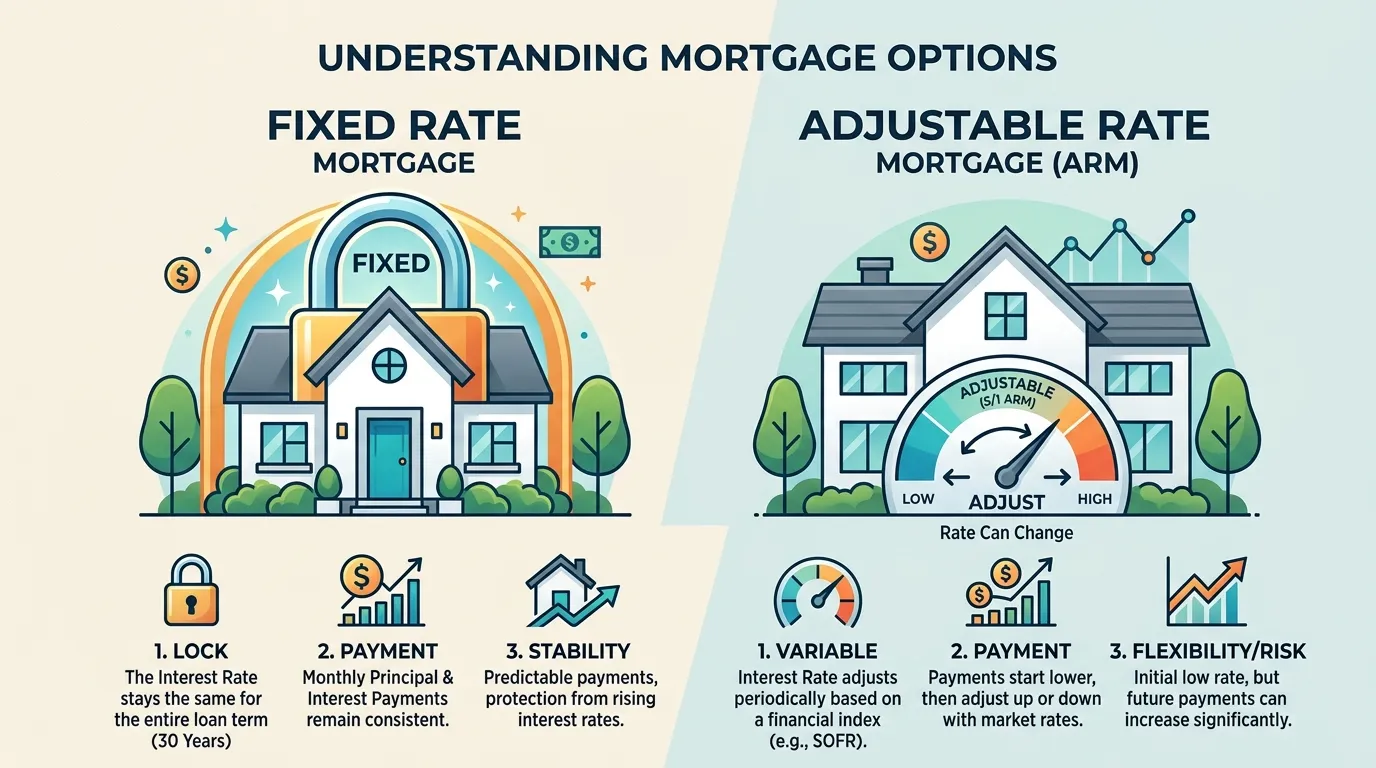
⚡ Action Checklist: How to Choose Between Fixed and ARM in 2026
Before selecting a mortgage loan structure with your underwriting lender, review these four strategic criteria:
- ✔Evaluate Your Expected Time in the Home: If you plan to relocate or upgrade within 5 to 7 years, an ARM's discounted introductory rate delivers pure interest savings before rate resets trigger.
- ✔Audit the ARM Rate Cap Structure (2/1/5): Ensure you understand your exact maximum periodic rate increase (often 2% first adjustment, 1% every 6 months thereafter, capped at 5% over life).
- ✔Check the Spread Between Fixed and ARM: In certain Treasury rate environments, the upfront rate discount on an ARM might only be 0.50%, making the long-term risk of fixed rate abandonment unjustified.
- ✔Never Plan Relying Solely on Refinancing: Do not sign an ARM with an absolute assumption that general rates will drop before year 6. You must be able to afford the maximum worst-case rate reset.
- Interest Rate: Guaranteed fixed for all 360 monthly installments.
- Monthly Payment: Principal and interest never change for 30 years.
- Refinancing Option: Can refinance without penalty if general market rates drop later.
- Best For: Forever-home buyers seeking structural budgeting certainty.
- Interest Rate: Fixed for first 5 years, then adjusts every 6 months.
- Monthly Payment: Starts significantly lower, but can rise dramatically after year 5.
- Rate Protection: Protected by contractual legal caps (e.g., maximum +5% over lifetime).
- Best For: Mobile professionals planning to sell or relocate within 6 years.
1. How Modern ARMs Function: Understanding the 5/6 and 7/6 Structure
Following historical lending reforms after the financial housing recession, modern adjustable-rate mortgages operate under rigorous, consumer-protective contractual parameters. When you evaluate a **5/6 ARM in 2026**, the naming convention denotes two precise operational phases:
The first digit (**5**) represents the initial introductory fixed-rate period in years. During this half-decade window, your interest rate is locked in just like a traditional fixed mortgage—usually at a discount of 0.75% to 1.25% below prevailing fixed loan benchmarks. The second digit (**6**) indicates how frequently your rate adjusts after the introductory term expires: **every 6 months** (bi-annually), tied to an objective market banking index such as the Secured Overnight Financing Rate (SOFR) plus a fixed lender margin.
According to regulatory mortgage protections published by the Consumer Financial Protection Bureau (CFPB), lenders must embed structural protective ceilings known as **Rate Caps**. A traditional 2/1/5 rate cap dictates that your interest rate cannot increase by more than 2% on the first adjustment, cannot rise more than 1% during any subsequent 6-month adjustment, and can never rise more than 5% above your original starting rate over the entire life of the property loan.
📊 Real-Life Case Study: David and Maya’s $450,000 Mortgage Comparison
David and Maya are buying a home with a $450,000 mortgage loan in 2026. David is a medical executive who anticipates a regional company transfer in exactly 5 years. Let's compare their financial cash flow between a 30-year fixed loan and a 5/6 ARM over a 5-year ownership horizon:
Option A: 30-Year Fixed at 6.85%
• Monthly Principal & Interest: $2,951/mo
• Total Payments over 5 Years: $177,060
• Remaining Mortgage Balance: $423,110
• Peace of mind, but higher daily borrowing cost.
Option B: 5/6 ARM at 5.75% (1.10% Discount)
• Monthly Principal & Interest: $2,626/mo
• Monthly Cash Savings: -$325/month!
• Total Payments over 5 Years: $157,560
• 5-Year Net Cash Savings: +$19,500 in pockets!
Takeaway: Because David and Maya successfully sold their property at year 5 just before the initial adjustment reset occurred, the ARM structure saved them $19,500 in pure interest expenses without exposing them to future rate inflation!
2. When Fixed-Rate Mortgages Dominate
While ARMs generate immense short-term liquidity, a **fixed-rate loan is the undisputed champion of family stability**. If you are purchasing an established permanent family residence where your children will attend schooling over the next two decades, trading long-term security for a temporary introductory discount creates unacceptable risk exposure.
Furthermore, when macro market rates eventually trend downward in economic easing cycles, fixed mortgage borrowers retain full operational flexibility to execute a formal loan refinance without absorbing upfront ARM reset volatility. Review our comprehensive architectural analysis of Mortgage Refinancing vs. Recasting to understand how homeowners restructure existing loan principal down the line.
3. Integrating Property Taxes, Insurance, and DTI Ratios
Regardless of whether you select a fixed or adjustable borrowing framework, mortgage underwriting banks evaluate your qualifying ability against rigid **Debt-to-Income (DTI)** standards. Your total proposed housing payment—including principal, interest, real estate property taxes, and home insurance (PITI)—must comfortably align with banking solvency limits.
Understand how institutional lenders evaluate your financial bandwidth in our analysis of The 28/36 Mortgage Affordability Rule, and learn how real estate tax buffering works in our definition of What is a Mortgage Escrow Account. You can test different borrowing thresholds directly using our Home Affordability Calculator or simulate early debt freedom via our Mortgage Payoff Calculator.
Frequently Asked Questions (FAQ)
Can I refinance out of an Adjustable-Rate Mortgage before the rate increases?
Yes! In almost all modern residential lending agreements, ARM loans carry zero prepayment penalties after the first three years. If general mortgage interest rates decline—or if you decide to reside in the property longer than anticipated—you can submit an application to refinance your ARM directly into a stable 30-year fixed loan at any point prior to your initial reset date.
What happens if market interest rates actually drop when my ARM adjusts?
If macro borrowing rate indexes (like SOFR) plummet below your introductory fixed benchmark by the time year 6 arrives, your adjustable interest rate will actually adjust downward automatically! Your monthly payment for the subsequent 6 months would decrease without requiring you to spend thousands of dollars in closing costs for a formal refinance.
Why do lenders offer lower interest rates on ARMs initially?
On a 30-year fixed mortgage, the financial bank absorbs 100% of the interest rate inflation risk over three decades. With an ARM, the borrower agrees to share future interest rate volatility risk after year 5 or 7. Because the financial institution carries less long-term structural inflation exposure, they reward the borrower with a significantly discounted upfront interest rate.