What Is Compound Interest (And How It Builds Wealth)
Albert Einstein reportedly called compound interest the "eighth wonder of the world." He who understands it, earns it. He who doesn't, pays it. Here is exactly how the math works.
Simple vs. Compound Interest Explained
To understand compound interest, you first have to understand simple interest.
Simple Interest is calculated only on the principal (your original money). If you invest $10,000 at 5% simple interest, you earn exactly $500 every single year. Forever. After 10 years, you have earned $5,000 in interest.
Compound Interest is interest calculated on the principal and the accumulated interest. You are earning interest on your interest.
| Year | Starting Balance | 5% Interest Earned | End Balance |
|---|---|---|---|
| Year 1 | $10,000.00 | $500.00 | $10,500.00 |
| Year 2 | $10,500.00 | $525.00 | $11,025.00 |
| Year 3 | $11,025.00 | $551.25 | $11,576.25 |
Notice how the interest earned grows every year without you doing any extra work. That is compounding.
The Compound Interest Formula
You don't have to be a math genius to build wealth, because our calculator does this for you. But it's helpful to know what is happening under the hood.
A = P(1 + r/n)^(nt)
- A = Final Amount (Future Value)
- P = Principal (Starting amount)
- r = Annual Interest Rate (as a decimal, so 5% is 0.05)
- n = Number of times interest is compounded per year
- t = Time (in years)
The Snowball Effect (Why It Starts Slow)
The hardest part about compound interest is human psychology. In the first few years, compounding looks incredibly unimpressive.
Imagine rolling a tiny snowball down a hill. On the first few rotations, it only picks up a few flakes of snow. But as it gets bigger, its surface area expands. By the time it reaches the bottom of the hill, every single rotation picks up massive sheets of snow.
Look at the math of investing $500 a month at a 9% return:
- Years 1-10: Your money grows from $0 to $96,000. (It took 10 painful years to hit nearly $100k).
- Years 11-20: Your money grows from $96,000 to $334,000. (The snowball is rolling faster).
- Years 21-30: Your money grows from $334,000 to $922,000.
In the last 10 years, you only contributed $60,000 of your own money, but the account grew by almost $600,000. That is the mathematical magic of exponential growth.
Why Compounding Frequency Matters (Daily vs. Annual)
In the formula, "n" represents how often the interest is calculated. The more frequently it calculates, the faster your money grows, because the interest is added to the pile sooner.
For example, if you invest $10,000 at 5% for 10 years:
Compounded Annually
$16,288.95
Compounded Monthly
$16,470.09
Compounded Daily
$16,486.65
This is why credit card companies compound your debt daily. It maximizes their profit. When looking for a High-Yield Savings Account, always check the fine print to ensure it compounds daily, not monthly or annually.
The Most Important Variable: Time
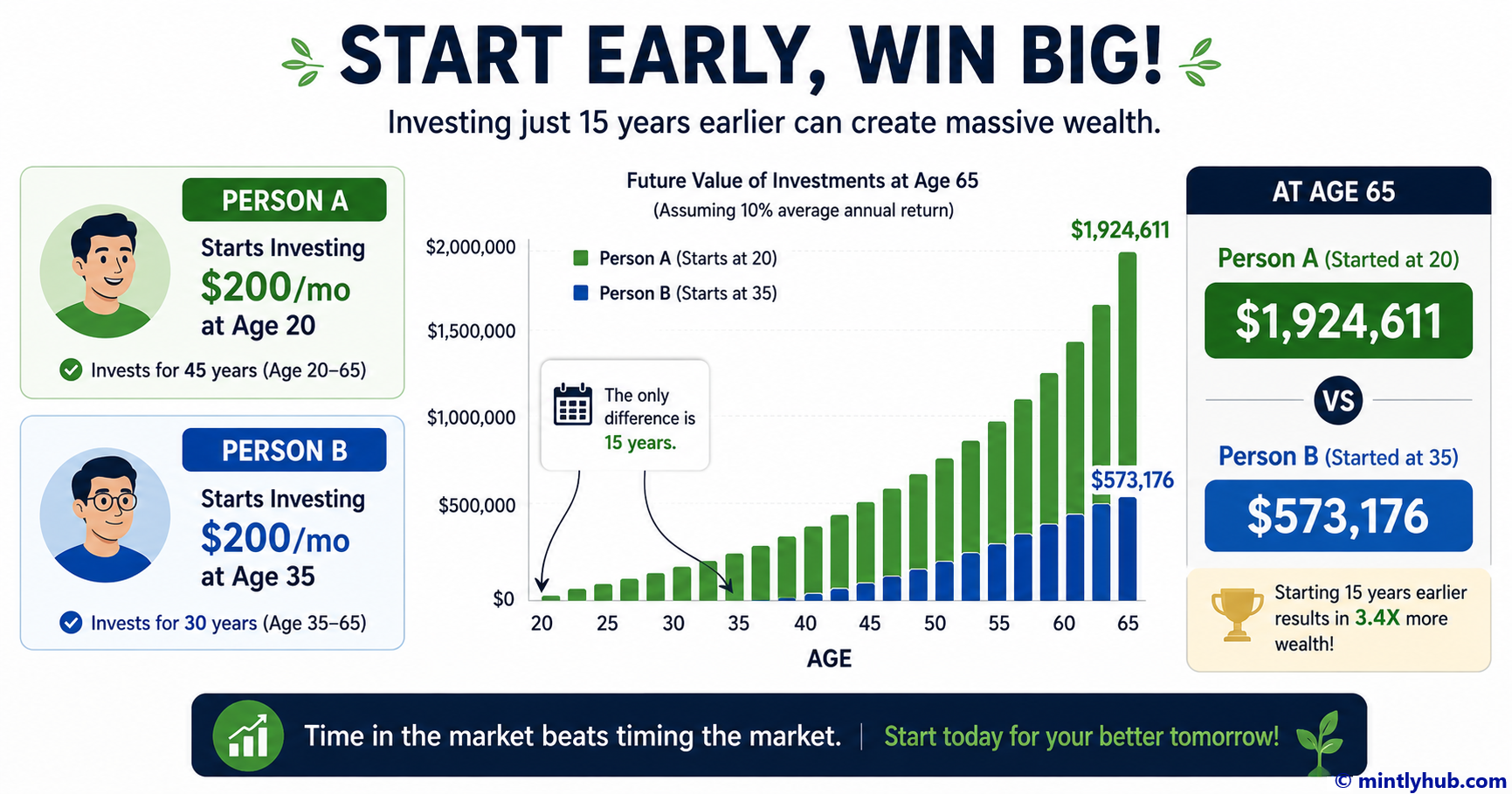
In the compound interest formula, the "t" (Time) is an exponent. Mathematically, the exponent is the most powerful part of the equation.
If you start investing at age 25, your money will double four separate times by age 61. If you wait until age 35 to start, your money will only double three times. Missing that final doubling phase will literally cut your retirement wealth in half, even if you invest the exact same amount of money.
Bottom Line
Compound interest is the mechanism that turns ordinary salaries into million-dollar portfolios. It requires no special skills or high IQ—it only requires consistency and time.