How to Refinance a Loan (Without Getting Scammed)
Banks love selling refinances by highlighting the lower monthly payment. But a lower payment doesn't always mean you save money. Here is the exact math to determine if a refinance is actually a smart financial move.
What is Refinancing, Really?
Refinancing is simple: You are taking out a brand new loan to pay off your old loan.Your old loan is closed, and you are left with the new loan, which comes with a new interest rate, a new timeline (term), and a new set of fees.
Because it is a brand new loan, the bank will charge you origination fees, appraisal fees, and administrative costs. These fees are the "cost of admission" to get the new, lower interest rate.
The #1 Mistake: The Term Trap
This is how banks trick people into bad refinances. Imagine you have a 30-year mortgage and you have been paying it for 10 years. You have 20 years left.
A bank offers you a new 30-year loan at a slightly lower rate. Because you are stretching the remaining balance over 30 years instead of 20, your monthly payment plummets. It feels like a massive win.
The Rule: If your goal is to save money, never refinance into a term that is longer than your current remaining term. If you have 22 years left, refinance into a 20-year or 15-year loan.
The Most Important Metric: The Break-Even Point
Refinancing is not free. A typical mortgage refinance costs 2% to 5% of the loan balance. If your loan is $300,000, closing costs might be $9,000.
To know if that $9,000 fee is worth it, you must calculate the Break-Even Point. This is how many months it takes for your monthly savings to pay for the upfront fees.
The Break-Even Formula
Total Fees ÷ Monthly Savings = Months to Break Even
- Example Fees: $6,000
- Example Monthly Savings: $150
- Math: $6,000 ÷ $150 = 40 months (3.3 years)
If you plan to sell the house or pay off the loan in 2 years, do not refinance. You would be losing money, because you paid $6,000 in fees but only stayed in the loan long enough to get $3,600 of savings back.
Step-by-Step Refinance Process
Check your credit score
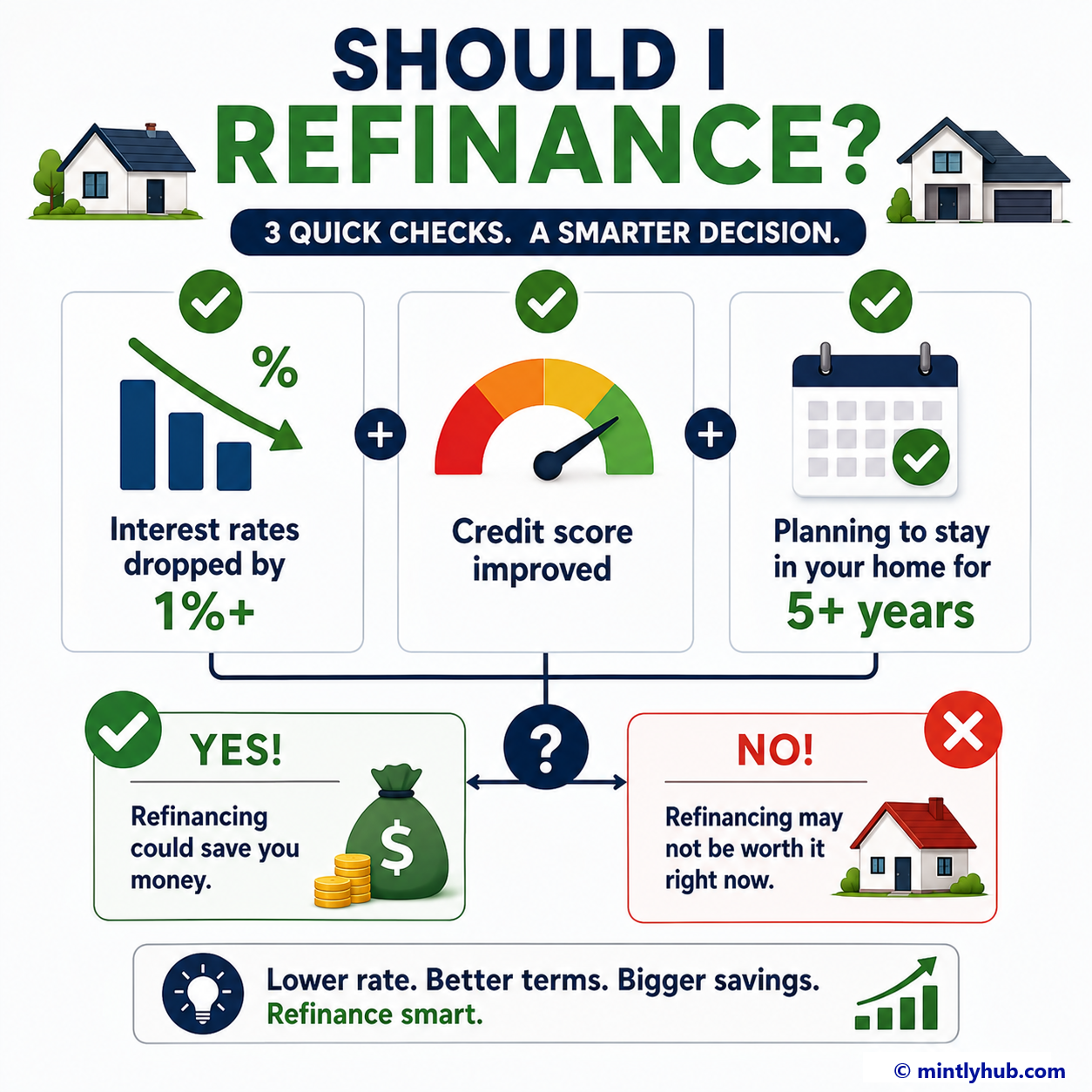
The best interest rates are reserved for scores of 740+. If your score has dropped since you took out the original loan, your new rate might actually be worse.
Find your exact current payoff amount
Check your latest statement for the "Payoff Balance" (not just the current balance) and note exactly how many months you have left on the loan.
Shop around (do not just use your current lender)
Get quotes from at least 3 lenders (a big bank, a local credit union, and an online lender). The CFPB found that shopping around saves borrowers an average of $3,000.
Run the math on the Loan Estimates
Lenders are required to give you an official "Loan Estimate" document. Plug the numbers from that document into our Refinance Calculator to see the true break-even point.
When Does It Make Sense to Refinance?
- The 1% Rule (Generally): You can drop your interest rate by at least 1.0% without extending the term of the loan.
- You are removing PMI: If your home value has gone up significantly, refinancing could eliminate Private Mortgage Insurance, instantly saving you hundreds a month.
- Switching from ARM to Fixed: If you have an Adjustable Rate Mortgage that is about to reset to a much higher rate, locking in a fixed rate brings security.
- Shortening the term: Refinancing from a 30-year to a 15-year mortgage will increase your monthly payment, but can save you over $100,000 in lifetime interest.
When Should You AVOID Refinancing?
- You plan to move soon: If you'll move before hitting your Break-Even Point, you lose money.
- You're almost done paying the loan: Amortized loans front-load interest. If you are in year 22 of a 30-year mortgage, your current payments are mostly going toward principal. A new loan restarts the clock, pushing you back to paying mostly interest.
- It's a "No Closing Cost" Refinance: There is no such thing. The bank simply pays the fees upfront and charges you a higher interest rate to compensate. You are still paying for it.
Bottom Line
A refinance is only as good as its break-even point. Ignore the sales pitch about "lowering your payment" and look strictly at the lifetime interest and the closing costs.
Use our calculator to put your current loan head-to-head against a refinance offer. Let the math make the decision for you.