Should You Pay Off Your Mortgage Early? The Mathematical Truth
Paying off a 30-year mortgage in 15 years sounds like a dream. But is it actually the best use of your money? Here is the step-by-step breakdown of how extra mortgage payments work, and the exact math you need to decide if you should do it.
The Trap of Amortization
Have you ever looked at your mortgage statement after paying on it for 5 years and realized your balance has barely moved? You are not crazy. You are experiencing amortization.
Banks structure mortgages so that you pay almost all the interest upfront. In the first few years of a 30-year mortgage, roughly 70% to 80% of your monthly payment goes straight to the bank as interest. Only a tiny fraction goes toward reducing your actual loan balance (the principal).
Example: $350k Loan at 6.5% for 30 Years
- Monthly P&I Payment: $2,212
- Month 1 Payment Breakdown: $1,895 to Interest, $317 to Principal
- Total Paid after 5 Years: $132,720
- Actual Debt Reduced after 5 Years: Only $22,400!
The bank gets their profit immediately. This is why paying the standard minimum payment feels like running on a treadmill for the first decade.
The Power of "Principal Only" Payments
Because standard payments are mostly interest, making extra payments is a cheat code. When you make an extra payment, 100% of it goes directly toward the principal balance.
Because your balance is now lower, next month's interest charge will be lower. This creates a compounding snowball effect in your favor.
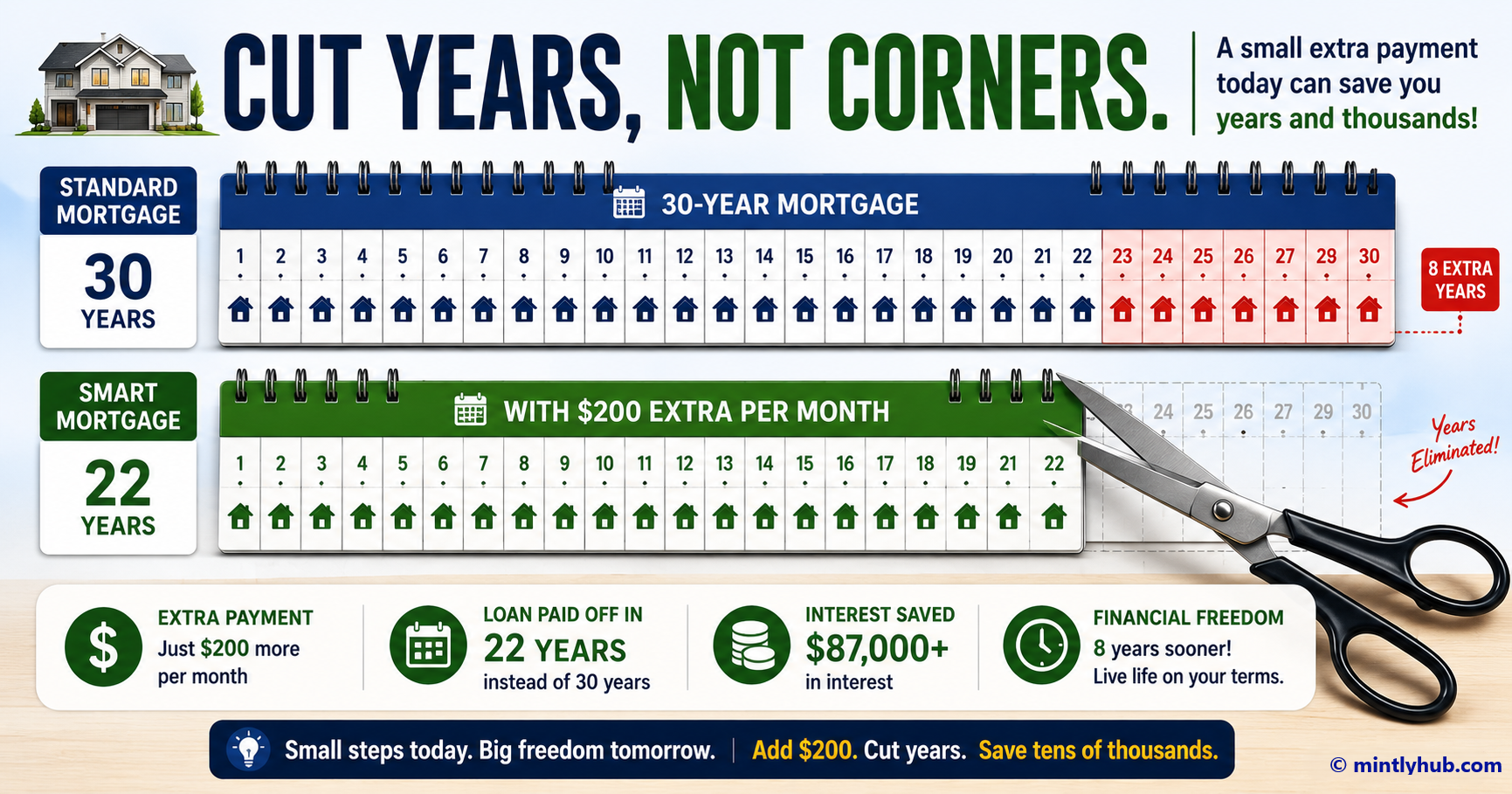
Use our Mortgage Payoff Calculator to see this in action. Adding just $200 extra a month to a standard mortgage can shave 5 to 7 years off the loan and save over $70,000 in interest.
The Great Debate: Investing vs. Paying Off Early
If you have an extra $500 a month, should you put it toward the mortgage, or invest it in the stock market? This is the most fiercely debated topic in personal finance.
| Factor | Paying Off Mortgage | Investing in Index Funds |
|---|---|---|
| Expected Return | Whatever your mortgage rate is (e.g. 3% to 7%) | Historically ~10% before inflation (S&P 500) |
| Risk Level | Zero Risk. The return is guaranteed. | Medium/High. The market can drop 30% in a year. |
| Liquidity | Poor. Your money is trapped in the house equity. | Excellent. You can sell stocks and get cash in 2 days. |
| Taxes | Tax-free (you are saving money, not earning income). | Taxable (capital gains taxes apply when you sell). |
When Investing Wins (The Mathematical Choice)
If you secured a mortgage between 2020 and 2022, you likely have an interest rate in the 2% to 4% range. Do not pay this mortgage off early.
If you borrow money at 3%, and inflation is 3%, the loan is practically free. You can put your extra cash into a standard High-Yield Savings Account earning 4.5% or index funds earning 10%, and mathematically come out far ahead.
When Paying Off Wins
If you bought a house recently, your interest rate might be 6.5% to 8%. At these rates, the math shifts dramatically. A guaranteed, tax-free 7.5% return (by paying off the mortgage) is incredibly attractive and often beats the stock market on a risk-adjusted basis.
The Psychological ROI of a Paid-Off House
Spreadsheets do not experience stress, anxiety, or job loss. Humans do.
Total Financial Freedom
For most families, the mortgage is 30% to 40% of their monthly budget. Imagine taking home your paycheck knowing that your housing costs are completely covered, permanently. The feeling of absolute security cannot be measured by a spreadsheet.
Recession-Proofing
If you lose your job, but your house is paid off, your emergency fund will stretch three times as far. You have the ultimate safety net.
How to Execute: Bi-Weekly Payments
If you want to pay off your mortgage faster but don't feel like you have extra cash in your budget, try the Bi-Weekly Payment Hack.
Instead of paying your mortgage once a month, divide your payment in half and pay it every two weeks (aligned with your paycheck).
Because there are 52 weeks in a year, paying every two weeks results in 26 half-payments. That equals 13 full monthly payments per year instead of 12. You seamlessly make one entire extra payment a year without feeling it in your monthly budget. This alone usually shaves 4 to 5 years off a 30-year loan.
Warning: Check with your lender first. Some lenders charge fees for bi-weekly setups or will just hold the half-payment in "escrow" until the end of the month, completely ruining the math. Ensure they apply bi-weekly payments immediately.
Bottom Line
If your mortgage rate is under 4%, invest your extra cash. If your rate is over 6%, paying down the mortgage is an excellent, risk-free investment.
Calculate your exact numbers using our tool to see exactly what an extra $100 or $500 a month will do to your timeline.