What is a Certificate of Deposit (CD)? (And Are They Worth It in 2026?)
When the Federal Reserve adjusts interest rates, a Certificate of Deposit (CD) becomes one of the most heavily debated financial products in America. Simply put, a CD is a contractual agreement between you and a bank: you agree to lock your money away for a specific period of time (the "term"), and in exchange, the bank guarantees you a specific fixed (the "APY"). While CDs offer absolute safety and predictable returns, the hidden danger lies in inflation erosion and severe early withdrawal penalties. Here is what you must mathematically consider before locking up your cash.
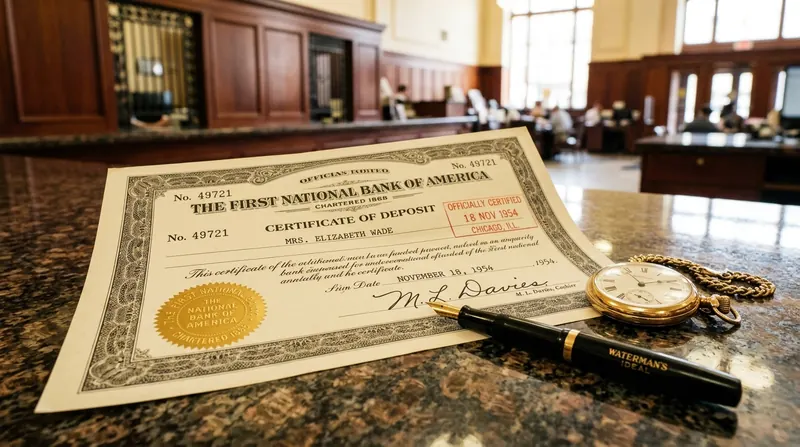
1. The Mechanics of a CD (How It Works)
Unlike a standard savings account where the interest rate can change overnight at the bank's discretion, a Certificate of Deposit locks in your Annual Percentage Yield (APY) for the duration of the term. Whether the economy booms or crashes tomorrow, the bank is legally obligated to pay you the exact rate you signed up for. For a detailed breakdown of how deposit terms and interest rates operate, see the FDIC certificate of deposit information.
The Catch: Liquidity. In exchange for that guaranteed high rate, the bank uses your money to issue mortgages and auto loans. Therefore, they penalize you if you break the contract early. If you need your money before the "Maturity Date," you will be hit with an Early Withdrawal Penalty, which typically strips away 3 to 6 months of the interest you earned—and in some extreme cases, can eat into your original principal.
2. Action Checklist: Before Opening a CD
Before transferring your hard-earned cash into a locked CD, run through this strict fiduciary checklist to ensure you aren't making a liquidity mistake.
✔ The Pre-CD Evaluation Checklist
- 1Verify Your Emergency Fund: Never put your 3-6 month emergency fund into a CD. If your car transmission breaks or you lose your job, you need instant, penalty-free access to cash. Use a High-Yield Savings Account (HYSA) instead.
- 2Calculate the Inflation Drag: If inflation is running at 3.5% and the CD pays 4.0%, your "real return" is only 0.5%. Do not use CDs for long-term wealth building; they are strictly designed for short-term capital preservation.
- 3Read the Fine Print on Penalties: Confirm exactly how many months of interest you forfeit if you withdraw early. A 1-year CD usually carries a 3-month interest penalty, while a 5-year CD can carry a 6-to-12 month penalty.
- 4Disable Auto-Renewal: Banks notoriously write contracts that automatically roll your money into a new CD at a potentially terrible rate when your term expires. Ensure you set a calendar reminder to withdraw the cash during the 7-day grace period.
3. Real-Life Scenario: The High-Yield Savings vs. CD Dilemma
How do you choose between a High-Yield Savings Account (HYSA) offering 4.5% and a 12-Month CD offering 5.0%? Let's run the exact mathematics on a $20,000 deposit.
Case Study: Locking in the Rate
Baseline: You have $20,000 saved for a house down payment needed in exactly 12 months.Scenario A (The HYSA at 4.5%): You place the $20,000 in an HYSA. Over the next year, the Federal Reserve cuts interest rates twice. Your HYSA rate drops from 4.5% down to 3.5% halfway through the year. Total Interest Earned: ~$800.
Scenario B (The 12-Month CD at 5.0%): You lock the $20,000 into a 1-Year CD at 5.0%. Even when the Federal Reserve cuts rates, your bank must legally honor the 5.0% contract. Total Interest Earned: $1,000.
The Financial Verdict: Because you knew exactly when you needed the money (in 12 months), the CD was the superior choice. You earned an extra $200 and shielded yourself from federal rate cuts. However, if you had needed the money in month 6 due to a medical emergency, the CD early withdrawal penalty would have wiped out your gains.
4. What is a "CD Ladder"?
A CD Ladder is an advanced banking strategy used to combat the liquidity problem. Instead of locking $30,000 into a single 3-Year CD, you split the money into three different CDs:
- $10,000 in a 1-Year CD
- $10,000 in a 2-Year CD
- $10,000 in a 3-Year CD
This ensures that $10,000 of your money matures and becomes completely liquid every single year. You can either use that cash, or "roll it over" into a new 3-Year CD at the back of the ladder. This strategy allows you to capture the higher interest rates of long-term CDs while maintaining yearly access to portions of your cash.
5. Frequently Asked Questions (FAQs)
Are Certificates of Deposit (CDs) safe?
Yes, they are among the safest financial instruments in existence. As long as you open the CD with an FDIC-insured bank (or NCUA-insured credit union), your principal is federally backed by the United States government up to $250,000. Even if the bank completely collapses, you will not lose a single penny of your deposit.
How is CD interest taxed?
Unless the CD is held inside a tax-advantaged retirement account (like an IRA), the interest you earn is taxed as ordinary income at both the federal and state level. Your bank will send you a 1099-INT form at the end of the year if you earn more than $10 in interest.
What is a "Brokered CD"?
A brokered CD is purchased through a brokerage account (like Vanguard or Schwab) rather than directly from a bank. Brokered CDs can often be traded on the secondary market, meaning you can sell them before maturity without paying a bank penalty, though their market value fluctuates based on current interest rates.
Do CDs pay compound interest?
Yes. Most modern CDs compound interest daily and credit it to your account monthly. The APY (Annual Percentage Yield) already accounts for this compounding effect over a 12-month period.