How to Dispute Credit Report Errors in 2026
A single error on your credit report can lower your FICO score and cost you thousands in higher interest rates. Here is the step-by-step, legal process to force the credit bureaus to correct or remove inaccurate information.
The Financial Impact of Credit Report Inaccuracies
A discrepancy on your credit file is not merely a clerical issue; it is a direct financial liability. According to a comprehensive study by the Federal Trade Commission (FTC), approximately one in five consumers has an error on at least one of their credit reports. When these inaccuracies involve late payments or fraudulent accounts, they suppress your credit score.
Consider the math on a $300,000, 30-year fixed mortgage. If an erroneous collection account drops your score from 740 to 670, your interest rate could increase by roughly 0.5%. Over the life of that loan, the lower score costs an additional $34,000 in interest payments. Addressing these errors promptly is a high-return financial task.
Identifying the Most Common Credit Reporting Errors
Errors generally fall into several distinct categories. Understanding what to look for accelerates the review process. The most prevalent issues stem from identity confusion, where accounts belonging to another person with a similar name or Social Security number appear on your file.
Account status errors are also widespread. Examples include accounts erroneously marked as late when paid on time, accounts reported as open when closed by the consumer, or the same debt listed multiple times by different collection agencies. Additionally, data management issues occur when negative information, such as a charge-off or bankruptcy, remains on the report beyond the legal seven-to-ten-year reporting limit.
How to Obtain and Analyze Your Statutory Free Reports
Under federal law, consumers are entitled to a free credit report weekly from Equifax, Experian, and TransUnion through AnnualCreditReport.com. This remains the sole government-authorized platform for accessing statutory free reports.
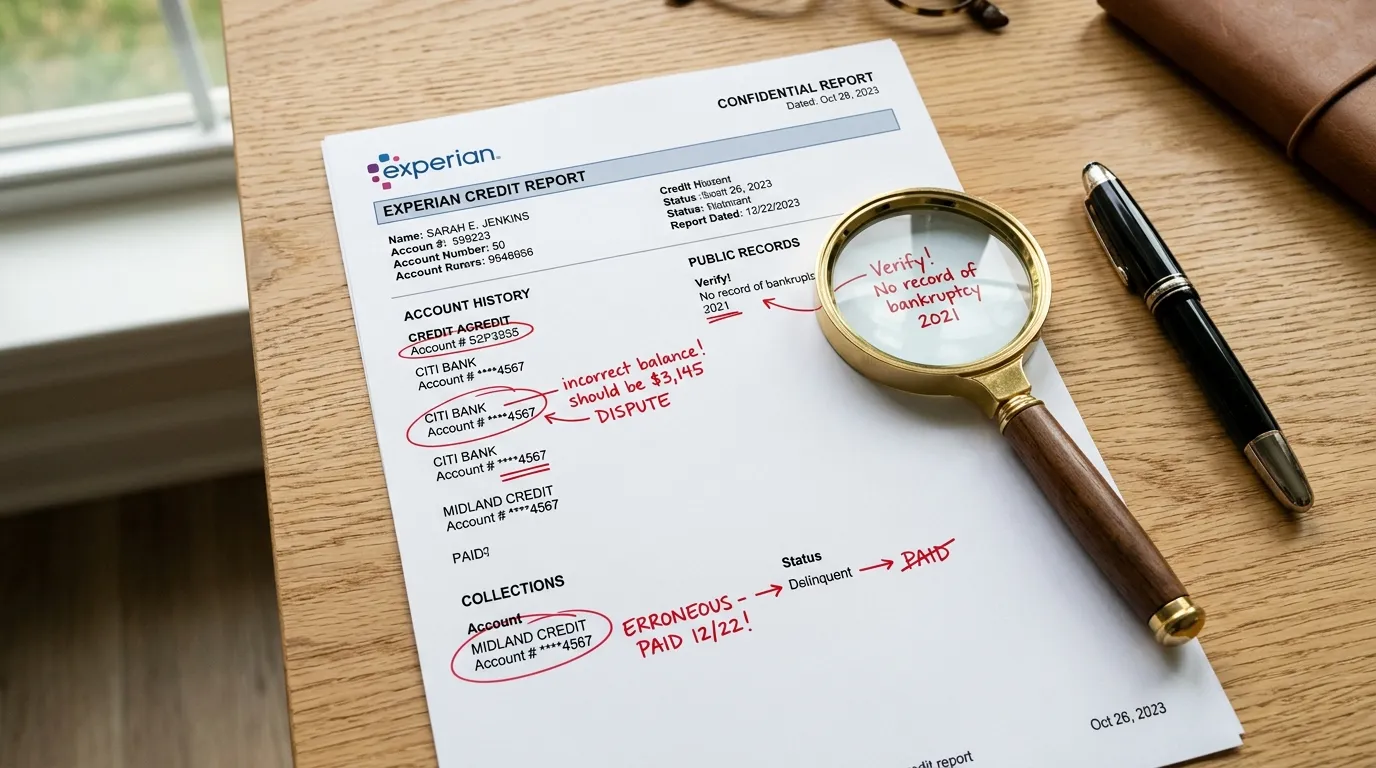
Once you download the reports, scrutinize the personal information section first. Incorrect addresses or employers can indicate mixed files or potential identity theft. Next, review the adverse accounts section line by line. Verify the dates of first delinquency and account balances. Highlight any data point that cannot be substantiated by your own financial records.
The Step-by-Step Dispute Process with Credit Bureaus
Initiating a dispute requires assembling documentation that refutes the inaccurate data. Gather bank statements showing timely payments, correspondence from lenders, or identity theft affidavits. Once your evidence is prepared, you must file a dispute with each credit bureau reporting the error.
Filing online through the bureaus' official portals offers the fastest turnaround. However, submitting a written dispute via certified mail with a return receipt requested establishes a definitive paper trail. Provide a clear, concise letter identifying the specific item in dispute, stating the facts, and explicitly requesting deletion or correction.
Upon receiving your dispute, credit bureaus typically have 30 days to investigate. They forward your evidence to the data furnisher, who must investigate their records. If the furnisher cannot verify the information, the bureau is required by law to remove or modify the disputed item.
Escalating Disputes to the Data Furnishers
Relying solely on the credit bureaus is sometimes insufficient. You hold the right to dispute inaccurate information directly with the data furnisher—the bank, credit card issuer, or collection agency that supplied the data. This dual-track approach applies maximum pressure for resolution.
Send a dispute letter directly to the furnisher's address listed on your credit report. Include copies of your evidence and state that you are disputing the accuracy of the information provided to the credit reporting agencies. Under the FCRA, the furnisher must conduct an investigation and notify the credit bureaus if the information is indeed incorrect.
What to Do If Your Dispute is Rejected
If the credit bureau responds that the information has been verified and remains unchanged, your options are not exhausted. First, request a description of how the bureau conducted its investigation, including the name and address of the furnisher contacted.
You can then submit a consumer complaint with the Consumer Financial Protection Bureau (CFPB). The CFPB acts as an intermediary, requiring the bureau or furnisher to respond formally to your complaint. Alternatively, you may submit a "Statement of Dispute" to the credit bureau, which will be attached to your file and visible to future lenders, providing context for the negative mark. In severe cases involving significant financial damages, consulting an attorney specializing in the FCRA may be necessary.
Frequently Asked Questions (FAQs)
Does disputing an error impact my credit score?
The act of filing a dispute itself has no direct impact on your credit score. If the dispute is successful and negative information is removed, your score will likely increase. While an item is under dispute, some scoring models may temporarily exclude it from your calculation.
How long do credit bureaus have to investigate a dispute?
By federal law, credit reporting agencies must conduct a reasonable investigation within 30 days of receiving your dispute. They can extend this to 45 days if you provide additional information during the initial 30-day window.
Are credit repair companies worth the cost?
Everything a credit repair company can do legally, you can do yourself at no cost. These companies charge monthly fees to mail dispute letters on your behalf. They cannot legally guarantee the removal of accurate negative information, and taking the DIY approach is often faster and much cheaper. For more on this, check out our guide on how to improve your credit score by 100 points.