What is Dollar-Cost Averaging (DCA)?
Definition
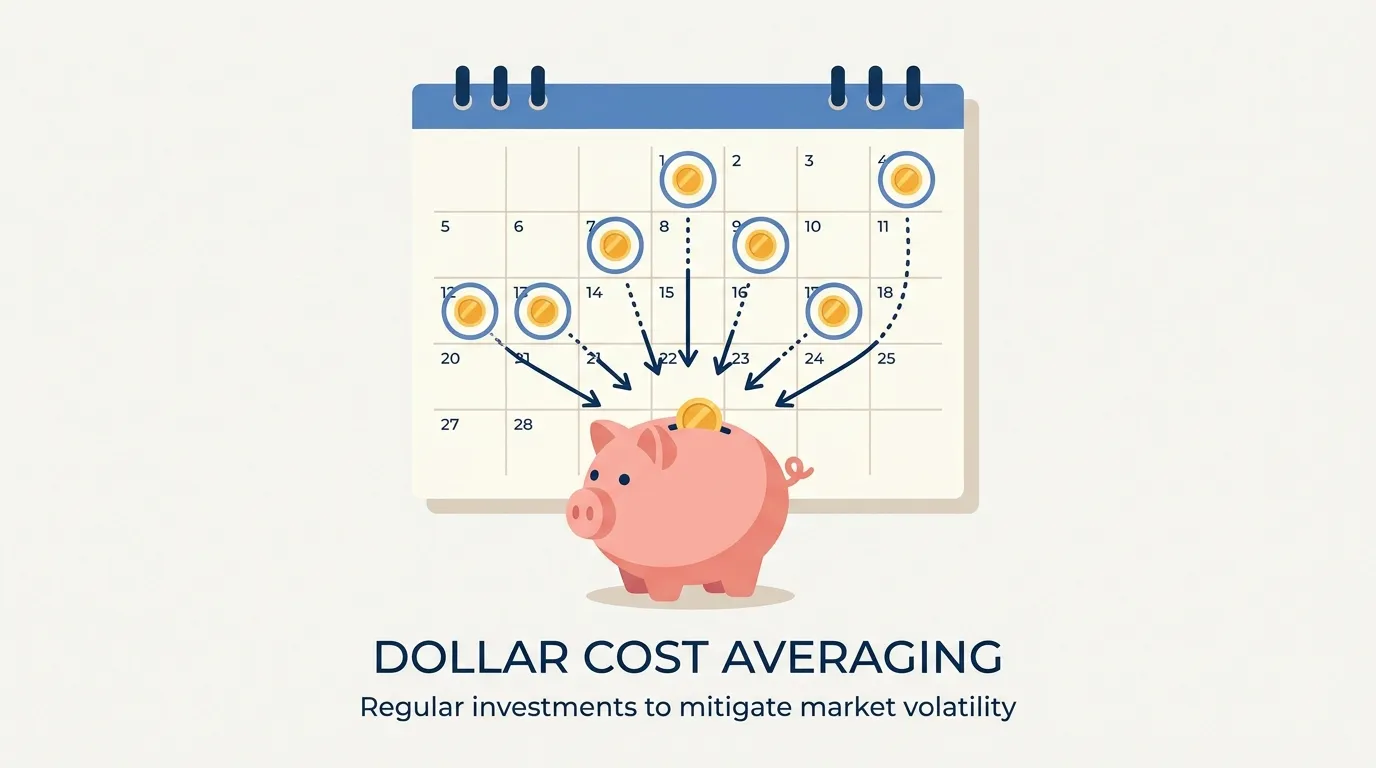
Dollar-Cost Averaging (DCA) is an investment strategy in which an investor divides up the total amount to be invested across periodic purchases of a target asset in an effort to reduce the impact of volatility on the overall purchase. For additional context, read about deductible and calculate your own numbers using our when can i retire. You might also find our guide on mutual fund helpful.
In simpler terms: Instead of trying to guess when the stock market is at its lowest, you invest a fixed dollar amount (like $200) every single month, no matter what the market is doing.
How It Works
Because you are investing a fixed dollar amount, you automatically buy more shares when prices are low, and fewer shares when prices are high. This mathematically averages out your purchase price over time. For more on building disciplined long-term investing habits, see SEC investor education.
Example of DCA
Let's say you invest $100 every month into Company XYZ:
- January: Stock price is $20. You buy 5 shares.
- February: Stock price falls to $10. You buy 10 shares.
- March: Stock price rises to $25. You buy 4 shares.
Total Invested: $300
Total Shares Owned: 19 shares
Average Cost Per Share: $15.78
Even though the price ended up at $25, your average cost was only $15.78 because you bought so many shares when it crashed in February.
Key Benefits of DCA
- Removes Emotion: You don't have to panic during a market crash. A crash just means stocks are "on sale."
- No Market Timing: Nobody can accurately predict the stock market. DCA guarantees you participate in long-term growth.
- Easy to Automate: Most brokerages allow you to set up automatic weekly or monthly deposits, meaning you build wealth on autopilot.
DCA vs. Lump Sum Investing
The alternative to DCA is "Lump Sum" investing—investing all your money at once. While historically estimate your closing costs slightly outperforms DCA because markets tend to go up over time, DCA is far superior for managing psychological risk and regret.
Read our full guide on rent vs buy in 2026.
Worked Example: The Power of Price Drops
The Math: In January, the fund costs $50 per share. Your $500 buys exactly 10 shares. In February, the market crashes and the fund drops to $25 per share. Your $500 now buys 20 shares. In March, the fund recovers slightly to $40 per share. Your $500 buys 12.5 shares.
The Outcome: Over three months, you invested $1,500 and acquired 42.5 shares. Your average cost per share is $35.29, which is significantly lower than the average mathematical price of the fund during that period ($38.33). You can visualize the compounding effect of these scheduled deposits using a earnest money.
Behavioral Benefits and Edge Cases
The true power of DCA is psychological. It entirely removes the emotional paralysis of trying to time the market. When the market drops, you are mathematically forced to buy stocks on sale. When the market rises, you buy fewer shares at a premium, naturally balancing your risk exposure.
However, an edge case occurs when you are holding a massive pile of cash. Statistically, the market goes up more often than it goes down. If you have a large windfall, dragging out a DCA strategy over 24 months will often underperform etf simply because a large portion of your cash sits idle in a checking account missing out on early dividend distributions.
