The Cash Envelope System: How to Stop Impulse Spending
If you struggle with or find yourself constantly overspending on things like dining out and groceries, the Cash Envelope System is the ultimate financial reset button. Made famous by financial experts decades ago, this simple method uses behavioral psychology to physically stop you from spending money you do not have.
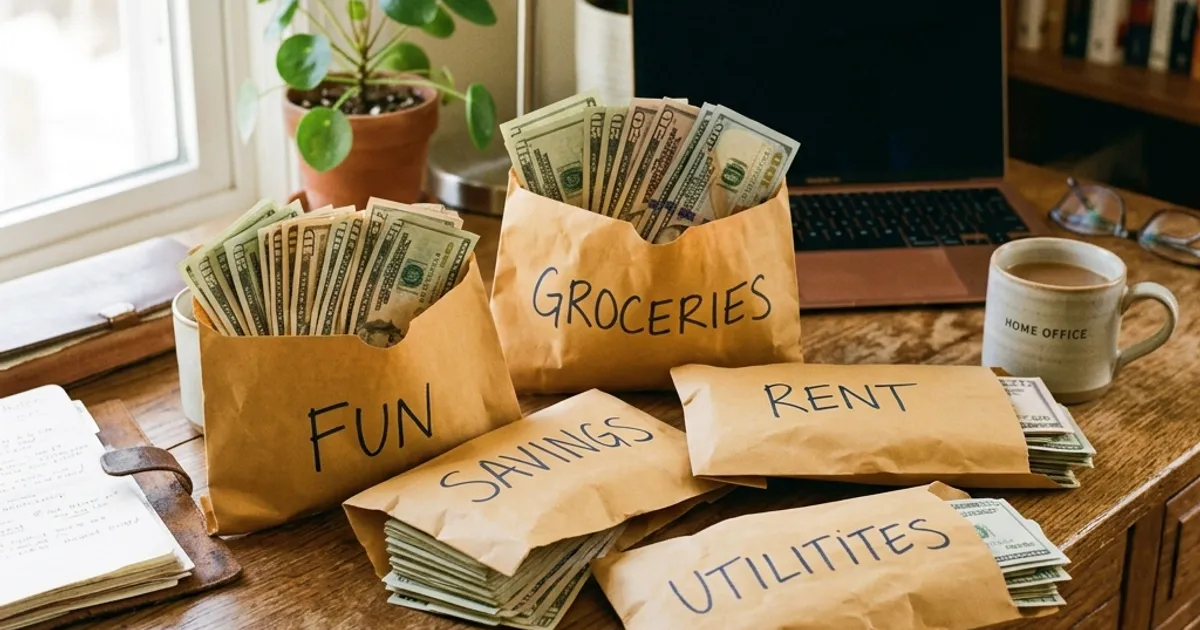
The Behavioral Psychology of Physical Cash
Swiping a debit card or tapping a smartphone to execute a transaction is an entirely frictionless process. Neurological studies demonstrate that because the transaction is invisible, the human brain often fails to register the financial loss. This disconnect is what leads to chronic overspending; a $50 dinner charged to a credit card feels mathematically identical to a $5 coffee.
The cash envelope system attacks this psychological loophole by reintroducing friction. When you are forced to hand over crisp, physical $20 bills, the pain centers in your brain are activated. You visually and tactilely experience the depletion of your resources. This biological response forces a necessary pause, prompting you to evaluate whether the purchase is genuinely necessary.
Furthermore, physical cash creates a hard mathematical boundary. If your "Dining Out" envelope is empty, you cannot generate more cash out of thin air. The transaction is instantly declined by the physical reality of an empty paper envelope, entirely removing the possibility of overdrafting a checking account or accumulating high-interest credit card debt.
Step 1: Calculating Your Discretionary Budget
Before you can stuff a single envelope, you must determine exactly how much cash you have available. The envelope system is designed strictly for variable, discretionary spending. You should not place your rent, mortgage, or fixed utility bills in an envelope; those should be paid electronically.
To calculate your envelope funding, begin with your total net monthly income. Subtract all fixed monthly expenses (rent, insurance, car payments, debt minimums). Next, subtract your automated savings contributions. The remaining figure is your discretionary budget. For example, if your net income is $4,000, your fixed expenses are $2,500, and your savings target is $500, you have exactly $1,000 left for variable spending.
If you are paid bi-weekly, divide that $1,000 by two. You will have $500 to allocate to your cash envelopes every single payday.
Step 2: Defining Your Spending Categories
The success of the envelope system depends on creating strict, non-overlapping categories for your discretionary spending. If a category is too broad, the money will disappear without accountability. If you have too many micro-categories, the system becomes overly complex and you will likely abandon it.
Most successful budgeters utilize four to six primary categories. Common examples include:
- Groceries: Strictly for supermarket purchases and household consumables.
- Dining Out: Restaurants, coffee shops, fast food, and bar tabs.
- Gas/Transportation: Fuel, parking fees, and public transit passes.
- Entertainment: Movies, concerts, hobbies, and subscription services.
- Personal Care: Haircuts, cosmetics, and clothing.
Review your past three months of bank statements to identify where you chronically overspend. Those specific problem areas are the categories that absolutely must be converted to physical cash envelopes.
Step 3: Funding the Envelopes (The Payday Routine)
The mechanical process of funding the envelopes requires discipline. On the exact day your paycheck clears into your checking account, you must physically visit a bank branch or an ATM. Withdraw the exact total amount required for your discretionary categories.
If your bi-weekly envelope budget is $500, you withdraw $500. Then, physically divide the bills into their respective envelopes based on the budget you established in Step 2. You might allocate $250 to groceries, $100 to dining out, $100 to gas, and $50 to personal care.
Once the money is distributed, the envelopes become the absolute law governing your financial behavior for the next two weeks. You must leave your credit cards and debit cards secured at home to ensure you cannot circumvent the system.
Step 4: The Golden Rules of the Envelope System
To prevent the system from collapsing, you must adhere strictly to three foundational rules. First, once an envelope is empty, spending in that category must cease immediately. You cannot borrow from another envelope, and you cannot return to the ATM.
Second, if you run out of grocery money three days before your next payday, you must eat whatever is left in your pantry. This manufactured scarcity teaches you how to pace your spending over a given timeframe.
Third, spouses and partners must be fully aligned. If one partner is using cash envelopes while the other continues to swipe a shared credit card, the budget will inevitably fracture. Both individuals must pull from the same physical cash reserves to maintain household accountability.
Digital Envelope Alternatives for Modern Banking
While physical cash is the most effective behavioral deterrent, some consumers find carrying large amounts of paper money impractical or unsafe. The financial technology sector has responded by digitizing the envelope concept.
Several modern banking applications (such as Ally Bank's "Buckets" or SoFi's "Vaults") allow you to partition a single checking account into visual sub-categories. You allocate funds digitally to a "Groceries Bucket" and a "Dining Out Bucket." As you spend using the bank's debit card, the app automatically deducts the amount from the correct digital envelope.
Alternatively, you can utilize third-party budgeting software like YNAB (You Need A Budget), which uses a zero-based digital envelope system. While digital envelopes are highly convenient and eliminate the need for ATM visits, they lack the physical friction of paper money. If you lack extreme discipline, the physical cash method remains the superior choice for breaking chronic overspending habits.
Handling Leftover Cash and Sinking Funds
A common scenario occurs when payday arrives, but you still have $30 remaining in your "Dining Out" envelope. You have two options for handling this surplus.
The first option is to roll the cash over to the next month, giving yourself a slightly larger dining out budget for the upcoming period. The second, and mathematically superior option, is to sweep all remaining cash into a savings vehicle. Take the leftover physical cash, deposit it back into your checking account, and immediately transfer it to your High-Yield Savings Account or an emergency fund.
Over the course of a year, sweeping $20 or $30 a week from various envelopes into a dedicated savings account can generate over $1,500 in additional wealth, entirely comprised of funds you deliberately chose not to waste.
Frequently Asked Questions (FAQs)
Can I do the envelope system digitally?
Yes. Many modern banking apps offer digital "vaults" or "buckets" that allow you to virtually divide your checking account balance into categories. When a bucket hits zero, you stop spending. It lacks the psychological pain of physical cash, but it provides a highly convenient alternative for those who prefer debit cards.
What do I do with the leftover change?
Put any coins and leftover dollar bills into a physical jar at the end of the day. At the end of the month, deposit that extra cash straight into your sinking fund or emergency savings account.
What if an emergency happens and I don't have my card?
It is advisable to keep a single credit card hidden in your vehicle's glove compartment or buried in your wallet specifically for true emergencies, such as a vehicle breakdown or medical issue. The goal is not to trap yourself, but to create enough friction that you do not use the emergency card for a fast-food run.