What is a Credit Card Balance Transfer? (And How to Avoid 5 Fee Traps in 2026)
Credit card issuers profit when your balance stays trapped in revolving 24% to 29% variable interest rates. A credit card balance transfer allows you to move existing high-interest debt onto a new card offering a temporary 0% introductory APR promotional window—typically lasting 12 to 21 months. When executed cleanly, every single dollar of your monthly payment stops servicing interest and directly reduces your principal balance. However, banks engineer specific upfront fee structures and backward-looking interest triggers into these agreements. Here is how professional financial planners navigate the balance transfer mechanism without stumbling into issuer fee traps in 2026.
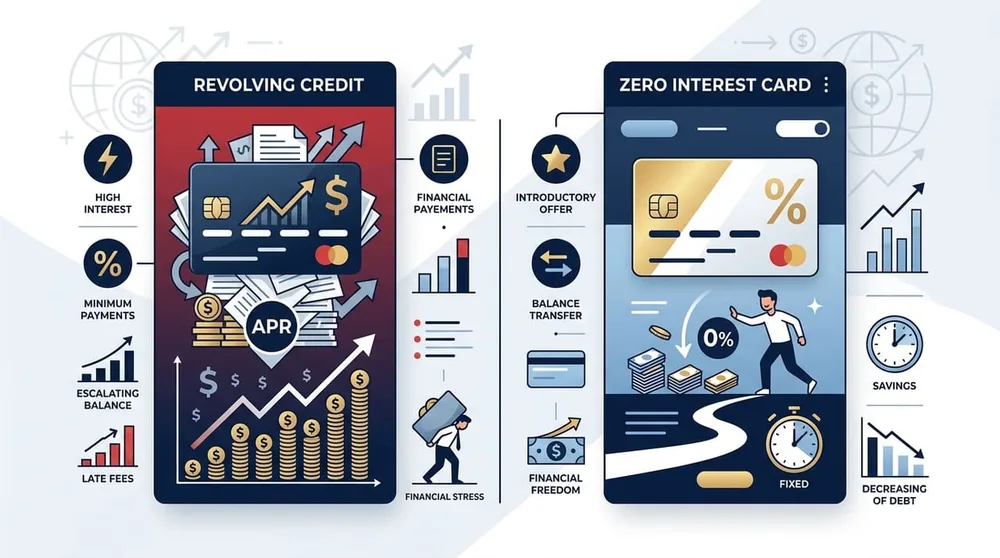
⚡ Action Checklist: 4 Steps Before Initiating a Balance Transfer
Before submitting an application for a 0% APR balance transfer offer, execute these verification checks:
- ✔Calculate the Upfront Fee Break-Even: Ensure the 3% to 5% balance transfer fee is significantly lower than the total compounding interest you would otherwise pay on your current card.
- ✔Verify Separate Bank Institutions: You generally cannot transfer balances between two credit cards issued by the exact same bank (e.g., from an old Chase card to a new Chase card).
- ✔Automate the Payoff Divider: Divide your total transferred balance (including fee) by the exact number of 0% months minus one, and automate that exact payment.
- ✔Lock the Card Away from New Purchases: Never make new retail purchases on a card holding a balance transfer, as many agreements charge immediate revolving APR on new spending.
1. The Mechanics of a Balance Transfer: Why Banks Give 0% APR
When you execute a balance transfer, your new credit card institution essentially issues a direct electronic payment or check to your old credit card bank, paying off the existing debt balance in full. That transferred sum then reappears on your new card ledger under a promotional introductory interest rate, typically 0% APR for 12 to 21 months.
Why do financial institutions offer lending at zero interest? Banks compete aggressively for high-income consumer relationships. Their actuarial models prove that nearly 40% of consumers who consolidate debt via balance transfers fail to repay the entire balance before the promotional window expires. Once month 13 or 22 hits, any remaining balance resets to the prevailing standard variable rate—often exceeding 26% APR in 2026.
According to consumer education resources from the Consumer Financial Protection Bureau (CFPB), credit card companies must clearly disclose all introductory window terms, standard rates, and transfer fee calculations on the application agreement before you sign.
2. The 5 Costly Fee Traps to Avoid in 2026
While 0% APR promotional periods provide massive relief, banks construct subtle contractual conditions designed to reclaim lost interest income. Be vigilant against these five common balance transfer hazards:
- Trap 1: The Upfront Balance Transfer Fee: Almost no zero-interest transfers are totally free. Banks charge an upfront transaction fee between 3% and 5% of the total amount transferred, added directly to your starting debt balance.
- Trap 2: Using the Card for Everyday Spending: Promotional 0% APR windows usually apply exclusively to the transferred debt balance, not to new retail purchases. If you buy groceries on the card, those purchases often accrue instant interest from day one without a typical grace period.
- Trap 3: Missing the 60-Day Transfer Window: Many promotional zero-rate credit cards stipulate that transfers must be formally completed within the first 45 to 60 days of account opening to qualify for the promotional APR rate.
- Trap 4: A Single Late Payment Penalty Reset: If you miss a required monthly minimum payment deadline by even one day, the terms of agreement permit the bank to permanently terminate your 0% promotional window and reinstate an immediate penalty APR up to 29.99%.
- Trap 5: Deferred Interest vs. True 0% APR: True bank credit cards waive interest entirely during the promotional term. However, many retail store financial promotions operate under "deferred interest" rules. If you leave even $1 unpaid when a deferred window closes, the issuer back-charges retroactive interest on the entire original balance from day one!
📊 Real-Life Case Study: Sarah’s $8,000 Balance Transfer Math
Consider Sarah, who currently carries an $8,000 balance on an old credit card charging 24.5% variable APR. She can afford to dedicate exactly $550 every month toward debt elimination. Let's compare two scenarios over a 15-month timeline:
Option A: Staying on Old 24.5% Card
• Monthly Payment: $550/mo
• Months to Zero: 18 Months
• Total Interest Charged: $1,644
• Total Cash Outlay: $9,644
Option B: 15-Month 0% Balance Transfer
• Transfer Fee (4% Upfront): +$320 fee ($8,320 total debt)
• Required Monthly Payoff: $554/mo for 15 mos
• Total Interest Charged: $0
• Total Net Savings: +$1,324 in pure cash!
Takeaway: Even after absorbing an upfront $320 transfer fee, Sarah crushes her debt 3 months faster and keeps $1,324 in her own savings account rather than handing it over to credit card underwriters.
3. Balance Transfer Card vs. Personal Consolidation Loan
A zero-interest balance transfer is not universally ideal for every borrower. If your total unsecured debt balances exceed $15,000, credit card underwriters may not approve a high enough promotional transfer limit to wipe out your original accounts in one sweep. Additionally, if you need 24 to 60 months to comfortably eliminate the debt, a temporary 15-month promotional APR window will close too early.
In such situations, a fixed-rate installment loan provides far greater structural predictability. Review our deep architectural financial comparison of Personal Loans vs. 0% Balance Transfer Cards to weigh upfront underwriting fees against predictable monthly installment schedules. You can also analyze your payoff trajectory using our Debt Snowball Calculator and review how revolving debt impacts your financial scores in our comprehensive 2026 Credit Score Guide.
Frequently Asked Questions (FAQ)
Does a balance transfer hurt your FICO credit score?
Initially, applying for a new credit card triggers a minor hard credit inquiry, which may temporarily dip your credit score by 5 to 10 points for a few months. However, once approved, your total available revolving credit line increases. Assuming you keep your old account open and do not rack up new spending, your overall credit utilization ratio decreases immediately, which typically boosts your credit score significantly over the following six months.
Can I do a balance transfer from one bank to another card at the same bank?
No. Virtually all major credit card issuing institutions (such as Chase, Citi, Capital One, or American Express) expressly prohibit intra-bank transfers. You cannot move a balance from one credit card to a promotional balance transfer card within the same bank family. You must transfer revolving debt across entirely separate competing financial institutions.
What happens if I cannot pay off the full balance before the 0% promotional window ends?
If any unpaid principal remains when your promotional introductory term expires (for example, at month 16 on a 15-month offer), the credit card automatically converts the remaining balance to the standard variable ongoing APR disclosed in your original agreement. On modern cards, this standard APR usually falls between 21% and 29%. To avoid interest re-acceleration, aim to clear the balance fully at least one month before expiration.