What is Amortization? (How Loan Repayment Schedules Work in 2026)
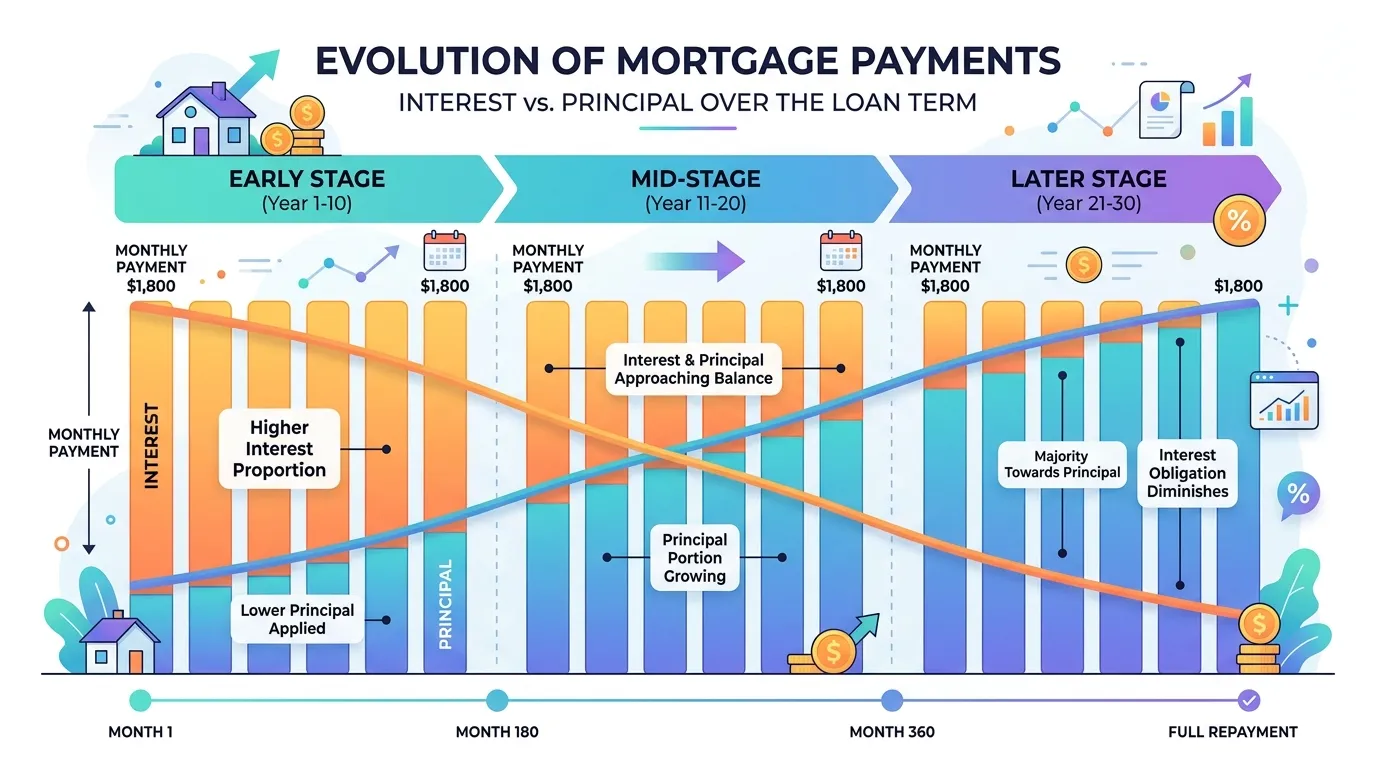
When you borrow money through an installment loan in 2026—such as a 30-year home mortgage, a 60-month auto loan, or a fixed personal loan—your repayment occurs through a systematic mathematical process called amortization. While your total monthly payment remains fixed every month, the internal breakdown between interest charges and principal debt reduction constantly shifts over the timeline. In early years, up to 80% of your payment evaporates into bank interest revenue, whereas final installments apply almost entirely toward extinguishing your underlying loan balance. Here is the insider mechanics of amortization schedules and how to use them to become debt-free years ahead of schedule.
⚡ Action Checklist: 4 Hacks to Beat the Amortization Interest Curve
You are not trapped into paying full lifetime amortization interest charges. Apply these four smart borrower moves:
- ✔Make ONE Extra Monthly Payment Per Year: By switching to bi-weekly payments or adding a 13th monthly installment directly to principal each December, you shave nearly 5 full years off a 30-year mortgage!
- ✔Specify "Apply Explicitly to Principal": Whenever submitting extra cash to your loan servicer online, explicitly check the box indicating "Principal Only" rather than advancing next month's due bill.
- ✔Recast Your Loan After a Lump Sum: If you come into a large bonus or inheritance, ask your lender for a "mortgage recast" to reset your required monthly payments downward without refinancing.
- ✔Avoid Extending Loan Terms When Refinancing: If you refinance a mortgage after paying for 5 years, do not restart a fresh 30-year amortization clock; opt for a 25-year or 20-year schedule instead!
1. The Architecture of an Amortization Table
Every formal lending agreement is accompanied by a document known as an **Amortization Table** (or repayment ledger). Because financial institution underwriting algorithms compute monthly interest charges directly against your outstanding revolving principal balance, your first payment generates the highest dollar amount of interest. As that first payment chips away at a microscopic slice of principal, the subsequent month's interest formula calculates against a slightly smaller debt balance.
According to consumer education releases by the Consumer Financial Protection Bureau (CFPB), understanding your amortization table is critical before signing any real estate or automotive contract, as it exposes the shocking lifetime cumulative cost of borrowing money over extended durations.
For example, on a standard 30-year fixed loan, you do not reach the "tipping point"—the exact installment month where your principal debt payment finally exceeds your interest payment—until roughly **year 13 or 14** of the repayment schedule!
📊 Real-Life Case Study: Robert’s $350,000 Mortgage Tipping Point
Robert takes out a $350,000 fixed mortgage at 6.50% interest over 30 years (360 monthly installments). His required monthly principal and interest payment is exactly $2,212/month. Notice how radically the internal payment composition shifts between Month 1 and Month 350:
Month 1 (Beginning of Loan)
• Total Payment: $2,212
• Bank Interest Portion: $1,896 (86%!)
• Debt Principal Portion: $316 (14%)
• Impact: $1,896 went to bank profits, only $316 built actual property equity!
Month 350 (Near Final Payoff)
• Total Payment: $2,212
• Bank Interest Portion: $121 (5%)
• Debt Principal Portion: $2,091 (95%!)
• Impact: Almost every dollar now goes toward final ownership liberation!
Takeaway: Because early amortization payments consist predominantly of interest, throwing even an extra $100 per month directly toward principal during the first 5 years of a loan eliminates thousands of dollars in compound lifetime interest charges!
2. Amortized Loans vs. Interest-Only & Balloon Loans
Not every loan in the United States uses fully amortized payment schedules. Understanding the classification differences protects borrowers from catastrophic debt surprises:
- Fully Amortized Loans: Standard fixed mortgages, personal debt consolidations, and federal student loans. Once you make the final payment on month 360 or month 60, your balance drops to exactly $0.
- Interest-Only Loans: Certain construction loans or commercial real estate credit lines allow borrowers to pay only monthly interest charges for an initial window (e.g., 5 years). During this period, zero amortization occurs, and your principal balance remains unchanged.
- Balloon Mortgages: Loans that feature small monthly amortized payments for a short duration (like 7 years), followed by a massive requirement to pay off the entire remaining hundreds of thousands of dollars in a single lump-sum "balloon payment" at maturity.
Learn more about foundational debt payoff methods in our guide on Debt Snowball vs. Debt Avalanche Math, and discover how lowering interest rates alters repayment schedules in our deep dive on When You Should Refinance a Loan in 2026.
Frequently Asked Questions (FAQ)
Does paying extra principal change my required monthly payment amount?
On a traditional fixed-rate amortized loan (like a standard mortgage), making extra principal payments will **not** reduce your billed monthly payment amount next month. Instead, it systematically shortens the total duration of your loan timeline, allowing you to finish paying off the loan years earlier while wiping out future interest charges. To lower your monthly payment without refinancing, you must request a formal mortgage loan recast from your lending servicer.
What is the difference between loan amortization and depreciation?
While both accounting terms describe spreading values over time, **amortization** specifically applies to paying down intangible debts and loans through scheduled repayment installments. **Depreciation**, on the other hand, describes the loss in economic resale value of a physical, tangible asset (such as an automobile or manufacturing machinery) over its useful operational lifespan due to physical wear and age.
Are credit cards considered amortized loans?
No. Credit cards represent open-ended **revolving credit facilities**, meaning they do not follow a set fixed amortization retirement timeline. Because minimum payment requirements fluctuate based on whatever floating balance you carry, paying only the minimum on credit cards can extend repayment out over decades. Review our warning analysis on What Happens If You Only Pay the Minimum on Your Credit Card to understand revolving compounding dangers.