What is Student Loan Forgiveness?
Student loan forgiveness occurs when you are legally relieved of your obligation to repay the remaining balance on your federal student loans. Once forgiven, the debt is wiped out permanently. For additional context, read about does student loan debt affect your credit score? and calculate your own numbers using our tax credits vs tax deductions. You might also find our guide on credit card balance transfer helpful.
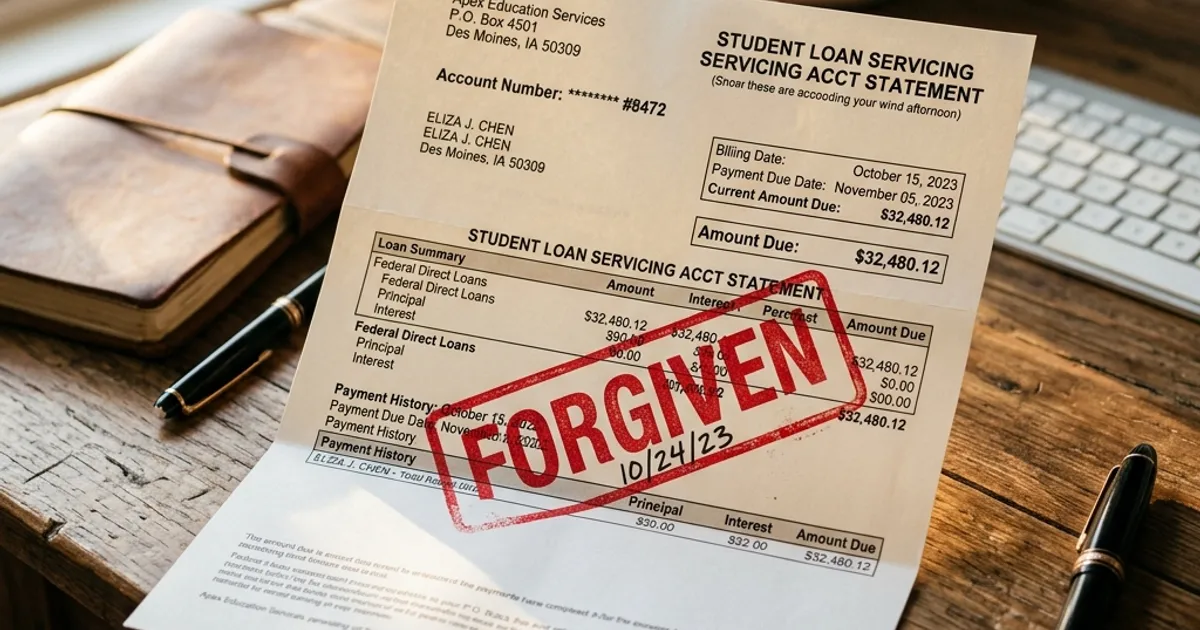
How Forgiveness Works
Forgiveness is not automatic. To have your loans wiped out, you must enroll in a specific government program and make qualifying payments for a set number of years. The two primary paths to forgiveness are Public Service Loan Forgiveness (PSLF) and Income-Driven Repayment (IDR) forgiveness. You can track your qualifying payment counts and apply for these programs through studentaid.gov.
PSLF forgives your remaining balance completely tax-free after 120 qualifying monthly payments (10 years) while working full-time for a government or non-profit employer. IDR forgiveness wipes out your balance after 20 or 25 years of payments under IBR (or 30 years under RAP) based on your income, regardless of where you work.
✔ The Private Loan Exception
Do not confuse federal loans with private debt:
- Federal Only: Forgiveness programs are exclusively funded and managed by the U.S. Department of Education. They only apply to federal direct loans.
- Private Debt: Banks and private lenders do not offer forgiveness. If you refinance your federal debt to get a lower rate, you permanently lose the ability to have your debt forgiven. Always compare federal vs. private student loans before acting.
Frequently Asked Questions (FAQs)
Is student loan forgiveness taxable?
It depends on the program. PSLF, Teacher Loan Forgiveness, borrower defense, and death or disability discharges remain completely tax-free at the federal level. The American Rescue Plan tax exclusion expired on December 31, 2025 and was not extended. From January 1, 2026, forgiveness under income-driven plans (IBR, RAP and others) is generally treated as taxable income for federal purposes, though state tax treatment varies.
How do I know if my payment qualifies?
To make a qualifying payment for PSLF, you must be enrolled in an IDR plan, pay the exact amount billed, and pay on time. You can use our IDR Payment Calculator to estimate your required monthly amount.
Worked Example: Public Service Loan Forgiveness (PSLF)
The Strategy: You enroll in an income-driven repayment plan. Because your starting resident salary is relatively low, your monthly payment is capped at $300. You must make exactly 120 qualifying monthly payments (10 years) while remaining employed by a qualifying non-profit or government entity.
The Outcome: Over 10 years (ignoring interest for simplicity), you pay $36,000 total. On month 121, the federal government entirely wipes out the remaining $114,000 balance, completely tax-free. You can calculate your own customized 120-month trajectory using an IDR payment calculator.
Common Mistakes and Edge Cases
The most catastrophic mistake borrowers make is assuming private student loans qualify for federal forgiveness. They do not. If you refinance federal loans with a private bank to secure a lower interest rate, you permanently strip away your legal right to pursue PSLF or any federal income-driven forgiveness. Before making irreversible moves, read our guide on how to pay off student loans fast to weigh the pros and cons of private refinancing.
Additionally, you must re-certify your income and employment every single year. Failing to submit this annual paperwork on time can pause your qualifying payment count and unexpectedly capitalize your unpaid interest into your principal balance.
